
16 November 2026 | Atmospheric Science
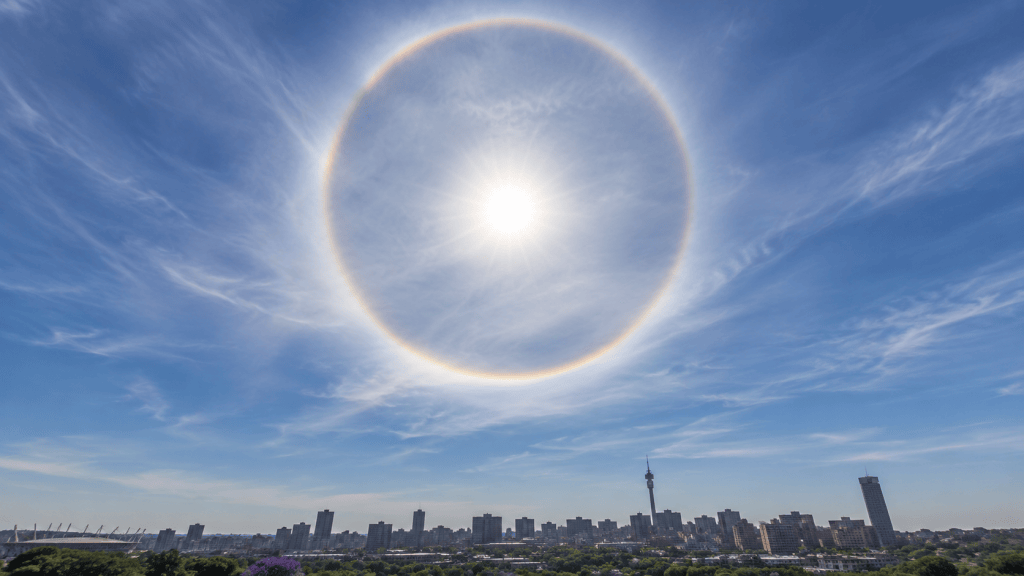
On Monday, 16 November 2026, a large, rainbow-like ring appeared around the Sun across parts of South Africa, attracting attention from people who witnessed the unusual sight.
The phenomenon, known as a 22-degree solar halo, was observed in Johannesburg, including at the University of the Witwatersrand (Wits), where researchers and students gathered to see the circular formation. Although it looks similar to a rainbow, a solar halo forms through a different atmospheric process involving sunlight, high-altitude clouds and tiny ice crystals.
What causes a solar halo?
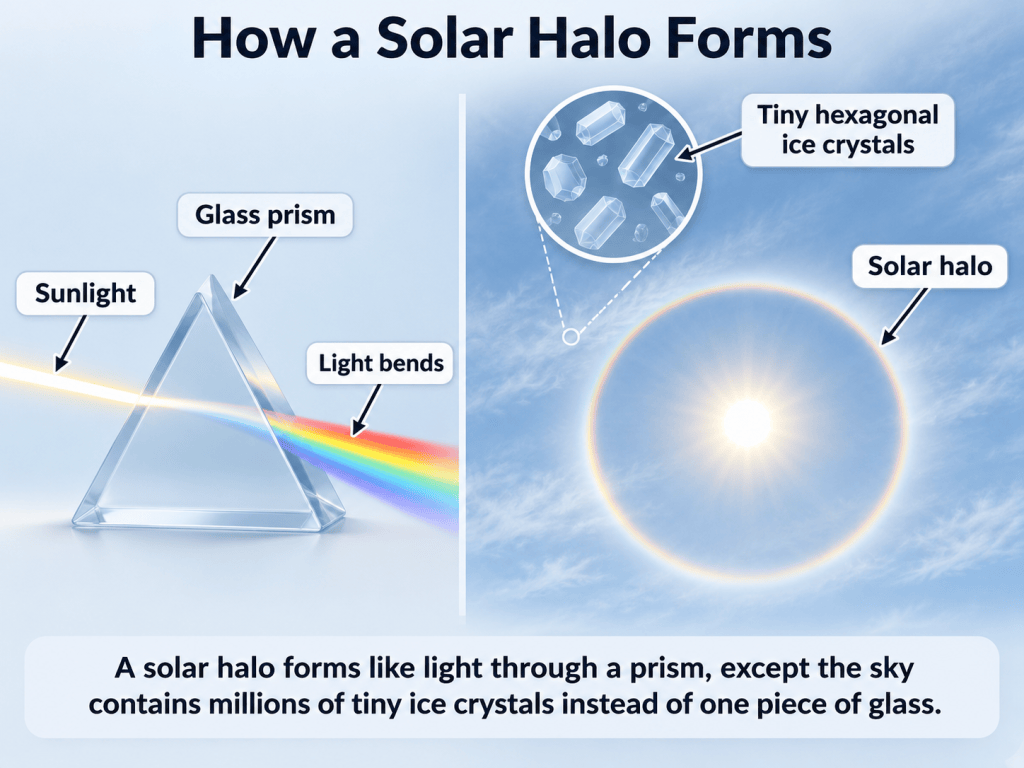
A solar halo forms when sunlight passes through millions of tiny ice crystals suspended high in the Earth’s atmosphere. An easy way to understand this is to imagine sunlight passing through a glass prism. As the light enters and leaves the glass, it changes direction and can separate into different colours.
A solar halo works in a similar way, except instead of one glass prism, there are millions of tiny ice crystals acting like miniature prisms in the sky. These ice crystals have a hexagonal (six-sided) structure and are found in thin, high-altitude clouds known as cirrus and cirrostratus.
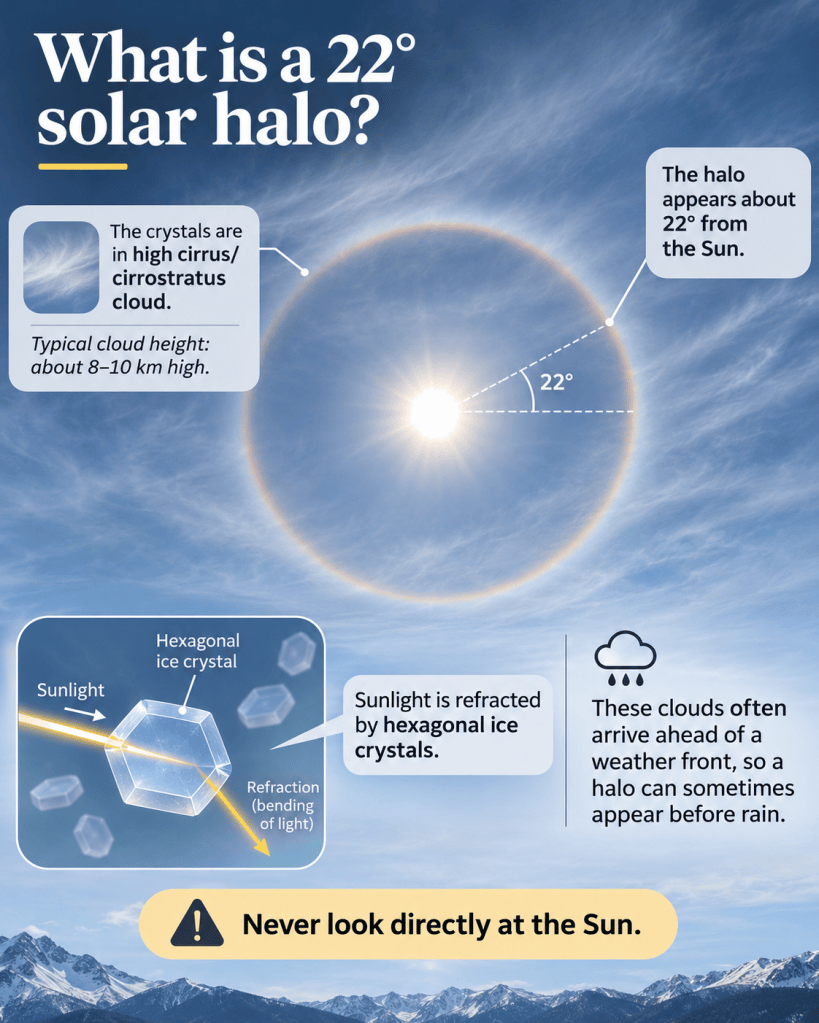
When sunlight passes through the crystals, it bends. This process is called refraction. Because of the shape of the crystals, much of the light reaching an observer is bent by approximately 22 degrees or more. With the crystals positioned in many different directions, the light forms a circular ring around the Sun.
This is why the phenomenon is called a 22-degree solar halo. The 22 degrees refers to the angular distance between the Sun and the inner edge of the ring, rather than the size of the ring itself.
Why does the halo look like a rainbow?
Sunlight may appear white, but it contains different wavelengths of visible light, which we see as different colours. When sunlight passes through the ice crystals, these wavelengths bend by slightly different amounts. This is known as dispersion.
Red light bends slightly less than blue or violet light, which explains why the inside edge of a solar halo can appear reddish, while the outer edge can have a faint blue colour.
However, solar halos often appear mostly white because the colours overlap and are not as clearly separated as they are in a rainbow.
How can there be ice crystals above South Africa in November?
Although November marks late spring in South Africa, temperatures several kilometres above the Earth’s surface are considerably colder than those experienced at ground level.
The ice crystals responsible for solar halos are typically found in the upper troposphere, the lowest layer of the Earth’s atmosphere.
Within the troposphere, temperature generally decreases as altitude increases.
Professor Jennifer Fitchett, a physical geographer at Wits University, estimated that the ice crystals responsible for the Johannesburg halo were approximately 8–10 kilometres above the Earth’s surface, where temperatures were between −30°C and −35°C.
At these temperatures, ice crystals can form and remain suspended within high-altitude clouds.
This explains how an optical phenomenon involving ice can occur above a region experiencing warm weather at ground level.
Can a solar halo tell us anything about the weather?
Solar halos are sometimes associated with approaching changes in weather conditions.
The cirrostratus clouds responsible for many halos can develop ahead of a weather front, where warm, moist air is gradually lifted higher into the atmosphere. As the air rises, it cools, allowing clouds containing ice crystals to form. These high clouds can appear before thicker, lower clouds develop and precipitation begins.
However, a solar halo does not necessarily mean rain is on the way.
During the Johannesburg observations, Professor Fitchett also reported lower clouds building, similar to those seen before thunderstorms the previous day.
While the halo showed that ice crystals were present in the upper atmosphere, additional observations would be needed to determine whether rainfall was likely.
How is a solar halo different from a rainbow?
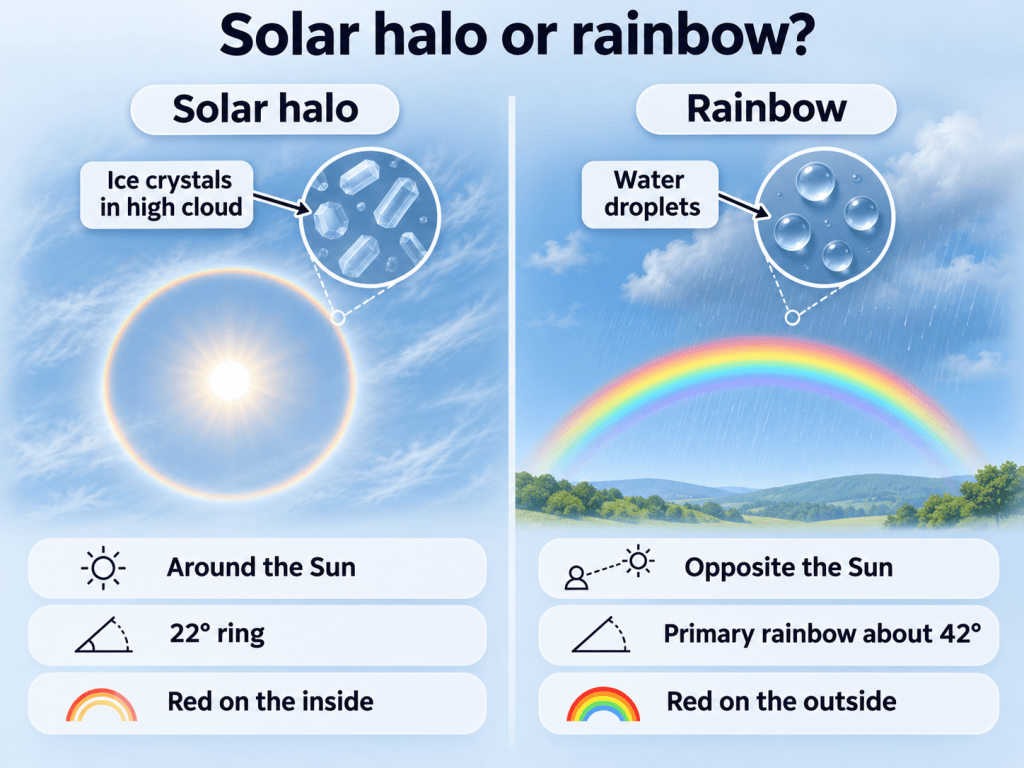
Although both phenomena involve sunlight being bent and separated into different colours, they form under different conditions.
| Solar halo | Rainbow |
|---|---|
| Forms when sunlight passes through ice crystals | Forms when sunlight interacts with water droplets |
| Appears around the Sun | Appears opposite the Sun |
| Usually associated with high-altitude clouds | Often observed when rain droplets are present |
| Red appears on the inner edge | Red appears on the outer edge |
| Typically has an angular radius of 22° | Primary rainbow has an angular radius of approximately 42° |
A rainbow involves refraction, internal reflection and dispersion within water droplets, whereas the common 22-degree solar halo is mainly produced by refraction through hexagonal ice crystals.
What does this tell us about the atmosphere?
The solar halo observed over South Africa demonstrates how several atmospheric processes interact to produce a visible phenomenon.
Temperature decreases with altitude through most of the troposphere, creating conditions where ice crystals can exist within high clouds, even when temperatures near the ground are warm. As solar radiation passes through these crystals, refraction and dispersion change the direction of the light and separate its wavelengths, producing the halo.
The appearance of cirrus and cirrostratus clouds can also provide information about moisture and atmospheric conditions at high altitudes. Solar halos are a good example of how the properties of sunlight, water and the atmosphere combine to create something visible from the Earth’s surface.
Although the ring may look unusual, the processes responsible are part of the normal behaviour of the atmosphere.
Safety: Never look directly at the Sun when observing a solar halo, as this can cause permanent eye damage. Photographs can be used to observe the phenomenon safely.
References
HOT 102.7 (2026) Solar halo turns heads across South Africa. 16 November 2026.
SABC News (2026) Sun halo excites Johannesburg residents. 16 November 2026.
Met Office (n.d.) Optical effects: nature’s light show.
Met Office (n.d.) High clouds.
Royal Meteorological Society (2026) Haloes and sun dogs.

