
Introduction
The ocean plays a fundamental role in regulating Earth’s climate, absorbing atmospheric carbon dioxide (CO₂), storing heat and supporting complex marine ecosystems. However, increasing greenhouse gas emissions and human activities are altering its physical, chemical and biological processes.
As part of my Open University Environmental Science studies, I explored four scientific papers examining ocean acidification, declining oxygen availability, the role of fish in carbon cycling, and marine temperature extremes.
Although each paper investigates a different aspect of ocean science, they reveal a common concern: changes in ocean temperature, chemistry and biological processes are interconnected, with potentially significant consequences for marine biodiversity and ecosystem functioning.
1. Ocean Acidification: Changing Seawater Chemistry
Research: Feely et al. (2023)
The ocean absorbs a substantial proportion of the carbon dioxide released through human activities. Although this helps reduce atmospheric CO₂ accumulation, it also changes seawater chemistry.
When CO₂ dissolves in seawater, it forms carbonic acid, which releases hydrogen ions (H⁺):
CO₂ + H₂O ⇌ H₂CO₃ ⇌ H⁺ + HCO₃⁻
Increasing hydrogen ion concentrations lowers seawater pH. At the same time, hydrogen ions react with carbonate ions (CO₃²⁻), reducing their availability. This is important because marine organisms such as corals, molluscs and some plankton require carbonate ions to form calcium carbonate shells and skeletons.
Key findings
Feely et al. (2023) analysed ocean observations and model data covering 1961–2020, identifying several significant changes:
- Surface ocean pH has decreased by approximately 0.11 units since the Industrial Revolution, representing a 30–40% increase in hydrogen ion concentration.
- Average surface ocean pH declined by approximately 0.016 units per decade across the observational period.
- Carbonate ion concentrations declined by approximately 5.1 µmol kg⁻¹ per decade.
- Aragonite saturation state declined by approximately 0.08 per decade.
Aragonite saturation state (Ωar) indicates how favourable seawater conditions are for forming and maintaining aragonite, a mineral used by many marine organisms.
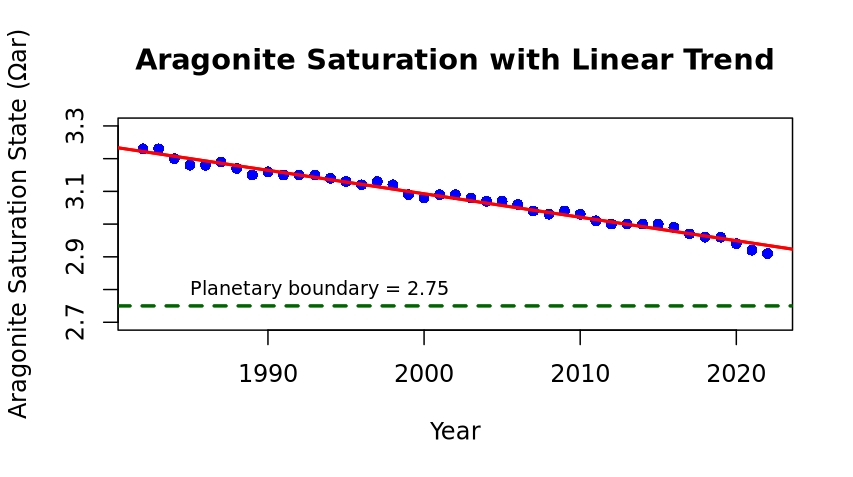
As Ωar decreases, shell formation can become more energetically demanding, and existing calcium carbonate structures may become increasingly vulnerable to dissolution. The researchers also identified geographical differences, with polar, subpolar and coastal upwelling regions particularly vulnerable.
What did I learn?
A relatively small decrease in pH can represent a substantial chemical change because the pH scale is logarithmic.
Ocean acidification is therefore not simply about seawater becoming less alkaline. It involves changes to the carbonate system that can influence organism survival, species distributions and marine food webs.
This research also helped me understand why aragonite saturation is an important indicator when assessing the planetary boundary for ocean acidification.
2. Ocean Deoxygenation: Increasing Hypoxia on Coral Reefs
Research: Pezner et al. (2023)
Ocean warming is contributing to declining dissolved oxygen concentrations, a process known as ocean deoxygenation.
Warmer seawater generally holds less dissolved oxygen than colder seawater. Increased stratification can also restrict the exchange of oxygen-rich surface water with deeper layers. At the same time, marine organisms consume oxygen through respiration, while decomposition of organic matter further reduces oxygen availability.
When oxygen concentrations become sufficiently low to cause biological stress, the condition is known as hypoxia.
Key findings
Pezner et al. (2023) examined oxygen measurements from 32 coral reef sites and found:
- 84% experienced weak to moderate hypoxia.
- 13% experienced severe hypoxia.
- Under a high-emissions scenario, more than 94% of the studied reef sites were projected to experience weak to moderate hypoxia by 2100.
- Under the same scenario, more than 31% were projected to experience severe hypoxia.
These projections are scenario-dependent rather than certain predictions. Coral reef organisms require oxygen for essential metabolic processes, including respiration, growth and reproduction. Reduced oxygen availability may therefore affect their health and survival.
What did I learn?
Before studying this research, I primarily associated coral reef degradation with rising temperatures and coral bleaching. However, the findings demonstrate that declining oxygen availability is another important environmental stressor.
I also learnt that oxygen conditions vary naturally throughout the day as photosynthesis produces oxygen and respiration consumes it. The combination of warming, hypoxia and acidification may place greater pressure on organisms than any single environmental change.
This reinforces the importance of investigating environmental stressors together rather than in isolation.
3. Marine Fish and the Biological Carbon Pump
Research: Bianchi et al. (2021)
The ocean’s biological carbon pump transfers carbon from surface waters into the ocean interior. Phytoplankton absorb CO₂ during photosynthesis, converting inorganic carbon into organic matter. This carbon then moves through marine food webs.
Some carbon is transferred into deeper waters when organic particles, including dead organisms and faecal material, sink. Fish contribute to this process through feeding, respiration, waste production and movement through the water column.
Key findings
Bianchi et al. (2021) used a marine ecosystem model to estimate historical fish biomass and investigate how fishing has altered biogeochemical processes.
Their research indicates that:
- Marine fish contribute to the movement and recycling of carbon and nutrients.
- Fish-produced organic particles contribute to carbon export from surface waters.
- Commercial fishing has reduced the biomass of exploited fish populations.
- These reductions have altered the estimated contribution of fish to carbon transport, remineralisation and oxygen consumption at depth.
The study demonstrates that fish have an important biogeochemical role beyond their contribution to marine biodiversity and fisheries. However, the findings are model-based estimates, and the precise global effects of fishing on long-term carbon storage remain uncertain.
What did I learn?
I previously understood the biological carbon pump primarily through phytoplankton photosynthesis and the sinking of dead organic matter. This research expanded my understanding by demonstrating that fish actively contribute to carbon cycling.
Fish do not simply consume carbon within the food web. They redistribute it through respiration, excretion, faecal pellets and vertical movement. An important distinction is that carbon export into deeper water does not necessarily mean permanent carbon storage. Some exported organic matter is decomposed and its carbon returned to dissolved forms.
The study illustrates why changes in marine populations can also affect wider biogeochemical processes.
4. Marine Heatwaves and Cold Spells Around the UK
Research: Jacobs et al. (2024)
Marine heatwaves are periods of unusually high seawater temperature lasting at least five consecutive days, generally defined relative to the historical temperature range for a particular location and time of year.
Marine cold spells represent unusually low temperatures over sustained periods.
Jacobs et al. (2024) investigated these events across the Northeast Atlantic, focusing on conditions around the UK and their relationship with marine ecosystem processes.
Key findings
The researchers found that:
- The UK is not currently a major global hotspot for marine heatwaves, although these events are expected to become more frequent.
- The southern North Sea experiences particularly high regional marine heatwave activity.
- An unusually intense marine heatwave affected UK waters in June 2023, lasting approximately 16 days.
- Marine heatwaves can coincide with low oxygen concentrations near the seabed, particularly in the southern North Sea and English Channel.
- The relationship between temperature extremes and phytoplankton biomass is complex, depending on nutrient availability, season and local environmental conditions.
The researchers also examined extreme chlorophyll-a conditions, describing unusually high concentrations as green waves and unusually low concentrations as blue waves.
Chlorophyll-a is used as an indicator of phytoplankton biomass, although the relationship between chlorophyll concentration and actual biomass can vary.
What did I learn?
This research highlighted that marine heatwaves are more complex than simply periods of warmer water.
The ecological consequences depend on the intensity, duration, timing and location of an event, as well as the presence of other environmental pressures.
For example, marine heatwaves occurring alongside low oxygen conditions may be particularly damaging to benthic organisms living on or near the seabed.
I also found the relationship between temperature and phytoplankton particularly interesting. Although warming can encourage biological activity under some conditions, stronger stratification may limit nutrient replenishment and reduce productivity.
This demonstrates why physical ocean processes, nutrient cycling and biological responses must be considered together.
5. Connecting the Four Studies: A Changing Marine System
The most important conclusion from reviewing these papers is that ocean warming, acidification, deoxygenation and changes in marine food webs are not independent processes.
They are connected through physical circulation, chemical reactions and biological activity.
Increasing atmospheric CO₂ contributes to both ocean warming and acidification.
Ocean warming reduces oxygen solubility and can strengthen stratification, potentially limiting the vertical mixing that supplies nutrients to surface waters and oxygen to deeper waters.
Ocean acidification alters carbonate chemistry, reducing the availability of carbonate ions needed by calcifying organisms.
Changes in marine communities, including those caused by fishing, can alter how organic carbon and nutrients move through marine ecosystems.
These processes can interact, producing additional stress for marine species.
| Environmental change | Main process | Potential ecological effect |
|---|---|---|
| Ocean acidification | Increased dissolved CO₂ changes carbonate chemistry | Reduced calcification and shell stability |
| Ocean warming | Rising seawater temperatures | Thermal stress, altered stratification and species distributions |
| Ocean deoxygenation | Declining dissolved oxygen | Reduced habitat suitability and physiological stress |
| Fishing pressure | Reduced fish biomass and altered food webs | Changes in biodiversity, nutrient recycling and carbon transport |
| Marine heatwaves | Sustained extreme temperatures | Compound stress, especially when combined with low oxygen |
These interactions highlight the importance of investigating marine ecosystems as interconnected systems rather than studying individual environmental variables separately.
6. Reflection: What Does This Mean for Marine Conservation?
These four papers have significantly developed my understanding of marine ecosystem functioning and the wider consequences of climate change.
A recurring theme is that environmental change can influence ecosystems through indirect pathways. For example, rising CO₂ changes seawater chemistry, which affects calcifying organisms, while warming can reduce oxygen availability and alter nutrient transport.
These changes can affect marine food webs, species distributions and the ecological processes that support ocean productivity.
I was particularly interested in the connection between marine fish populations and carbon cycling. It demonstrates that biodiversity conservation is not only about protecting individual species but also about maintaining ecological functions.
The studies also emphasise the importance of long-term environmental monitoring. Measurements of temperature, dissolved oxygen, pH, carbonate chemistry and biological activity allow researchers to identify trends, investigate interactions and improve predictions.
From a conservation perspective, reducing greenhouse gas emissions remains essential for limiting warming, acidification and deoxygenation. Sustainable fisheries management, habitat protection and improved environmental monitoring can also help reduce additional pressures.
Conclusion
The ocean is experiencing significant physical, chemical and biological changes driven by climate change and human activities.
Together, the four studies demonstrate that increasing atmospheric CO₂, rising seawater temperatures, oxygen loss and changes in marine food webs are affecting the processes that support marine ecosystems.
My principal learning is that marine biodiversity, ocean chemistry and climate regulation are closely connected. Understanding these relationships is essential for predicting environmental change and developing effective conservation strategies.
Questions for Further Learning
- How might simultaneous ocean warming, acidification and deoxygenation affect the distribution of marine species?
- Could restoring depleted fish populations influence marine carbon cycling and long-term carbon storage?
- How will changes in ocean stratification affect nutrient availability and phytoplankton productivity?
- Which UK marine habitats are most vulnerable to the combined impacts of marine heatwaves and declining oxygen concentrations?
- How can long-term monitoring distinguish natural ocean variability from human-driven environmental change?
References
Bianchi, D., Carozza, D.A., Galbraith, E.D., Guiet, J. and DeVries, T. (2021) ‘Estimating global biomass and biogeochemical cycling of marine fish with and without fishing’, Science Advances, 7(41), eabd7554. https://doi.org/10.1126/sciadv.abd7554
Feely, R.A. et al. (2023) ‘Acidification of the global surface ocean: What we have learned from observations’, Oceanography, 36(2–3), pp. 120–129. https://doi.org/10.5670/oceanog.2023.222
Jacobs, Z.L. et al. (2024) ‘Marine heatwaves and cold spells in the Northeast Atlantic: What should the UK be prepared for?’, Frontiers in Marine Science, 11, 1434365. https://doi.org/10.3389/fmars.2024.1434365
Pezner, A.K. et al. (2023) ‘Increasing hypoxia on global coral reefs under ocean warming’, Nature Climate Change, 13, pp. 403–409. https://doi.org/10.1038/s41558-023-01619-2

