
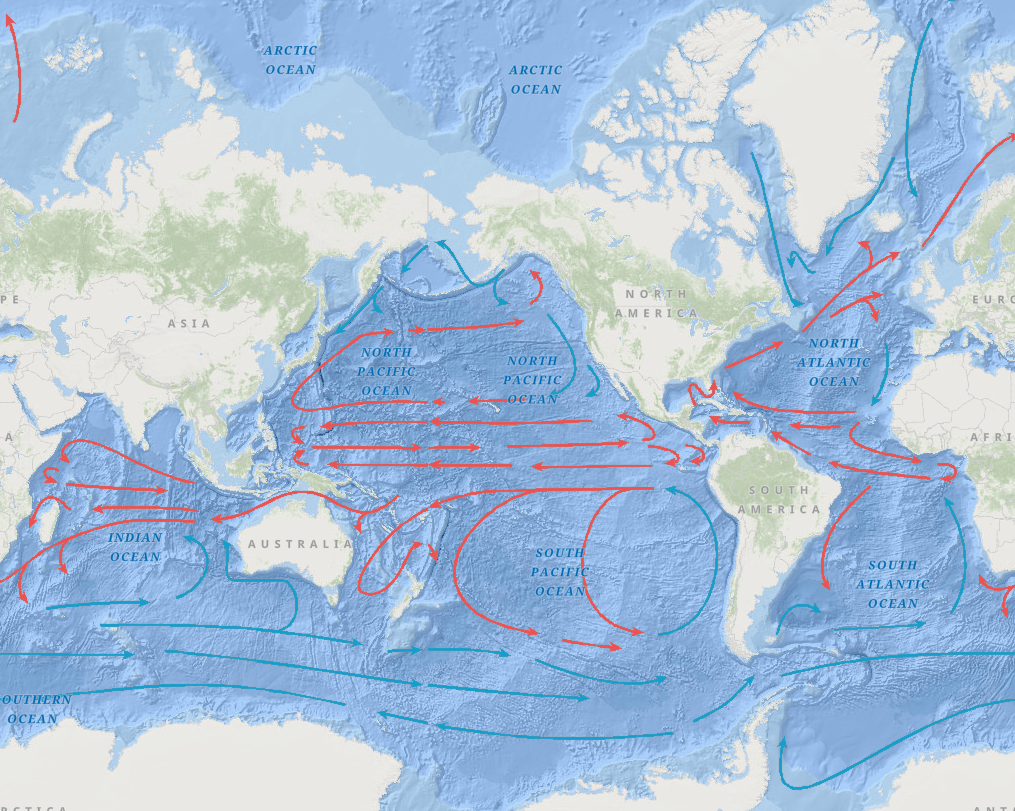
Learning Journal | Environmental Science | Physical Oceanography
Introduction: One interconnected ocean
Although we commonly refer to the Atlantic, Pacific, Indian, Southern and Arctic Oceans as separate geographical regions, they form a single, interconnected body of water. Ocean currents continuously redistribute heat, dissolved substances, nutrients and gases between these regions, influencing Earth’s climate and the distribution of marine life.
Studying ocean circulation has encouraged me to consider the oceans not simply as geographical features, but as part of a complex physical and biological system. What happens in one ocean basin can influence environmental conditions thousands of kilometres away.
This raises an important question: What drives the movement of such enormous volumes of water, and how do relatively small changes in temperature or salinity influence circulation on a global scale?
To explore this, I have looked at the molecular properties of water, the vertical structure of the oceans, wind-driven surface currents and the processes responsible for deep-ocean circulation.
1. The physical properties of seawater
Why is water so important to Earth’s climate?
An understanding of ocean circulation begins with the molecular structure of water.
Water (H₂O) is a polar molecule. Oxygen attracts the shared electrons more strongly than hydrogen, creating a partial negative charge around the oxygen atom and partial positive charges around the hydrogen atoms. This separation of electrical charge is known as polarity.
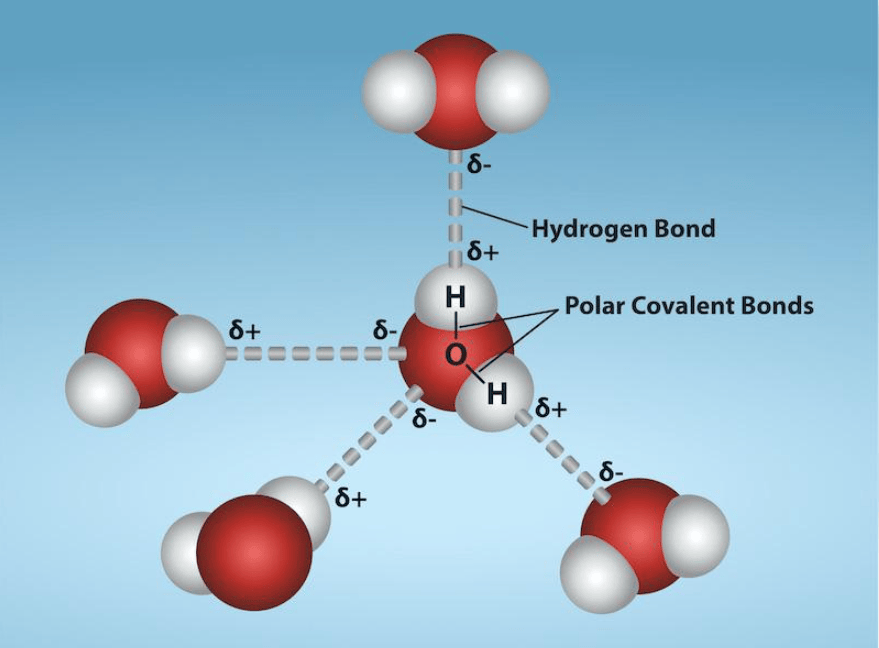
The attraction between hydrogen atoms in one molecule and oxygen atoms in neighbouring molecules produces hydrogen bonds. Although individually weaker than the covalent bonds holding each water molecule together, hydrogen bonds collectively influence many of water’s physical properties.
One particularly significant property is its high specific heat capacity, approximately 4,200 J kg⁻¹ K⁻¹ for freshwater near room temperature.
This means that approximately 4,200 joules of energy are needed to raise the temperature of one kilogram of water by one kelvin (equivalent to a one-degree Celsius temperature change).
The relationship can be expressed as:
Q = mcΔT
Where:
- Q = heat energy transferred (J)
- m = mass of water (kg)
- c = specific heat capacity (J kg⁻¹ K⁻¹)
- ΔT = temperature change (K)
For example, heating 2 kg of water by 3°C requires approximately:
Q = 2 × 4,200 × 3 = 25,200 J
This ability to absorb and store considerable quantities of thermal energy without rapidly changing temperature helps explain why the oceans moderate global and regional climates.
Water also has a high latent heat of vaporisation. Considerable energy is absorbed during evaporation and subsequently released during condensation. This transfers energy between the ocean and atmosphere and contributes to the global climate system.
Question for further consideration: If the oceans had a substantially lower specific heat capacity, how might seasonal temperature variations and regional climate patterns differ?
Salinity and the chemical composition of seawater
Seawater contains dissolved ions, predominantly chloride (Cl⁻) and sodium (Na⁺), alongside sulphate, magnesium, calcium and potassium.
The mean absolute salinity of surface seawater is approximately 34.9 g kg⁻¹, although substantial geographical variation occurs.
Absolute Salinity (As) describes the mass of dissolved material per kilogram of seawater and is expressed in g kg⁻¹. This differs from Practical Salinity, which is calculated from conductivity measurements and is dimensionless.
An important principle is the constancy of composition: the relative proportions of the major dissolved ions in open-ocean seawater generally remain approximately constant, even when total salinity changes.
However, salinity is not geographically uniform.
- Evaporation removes water but leaves most dissolved salts behind, increasing salinity.
- Precipitation introduces freshwater, reducing salinity.
- River discharge and ice-sheet melt can reduce surface salinity.
- Sea-ice formation excludes much of the dissolved salt, increasing the salinity of the surrounding water.
These processes influence seawater density and therefore ocean circulation.
An important distinction: Salinity is not simply a measure of sodium chloride. It represents the wider dissolved salt content of seawater.
2. Temperature, salinity and density
Why does seawater sink?
Ocean Voxels (Explore the oceans temperature and salinity in 3D)
Seawater density is influenced principally by temperature, salinity and pressure.
Generally, cooling seawater increases its density, while increasing salinity also makes seawater denser. Pressure additionally increases density at greater depths.
This relationship is fundamental to the formation of deep water masses.
When surface seawater cools, it can become denser than the water beneath it. This produces an unstable arrangement, and the denser water may sink, displacing less dense water upwards. The resulting vertical circulation is known as convection.
The situation becomes particularly important at high latitudes, where atmospheric cooling and sea-ice formation can increase surface-water density.
However, temperature and salinity do not operate independently. Warm, highly saline seawater may be denser than colder, relatively fresh water.
Therefore, temperature alone cannot determine whether a water mass will sink.
Oceanographers quantify seawater density using the thermodynamic equation of seawater, accounting for temperature, Absolute Salinity and pressure.
A commonly used density anomaly is:
σθ = ρθ − 1,000 kg m⁻³
Here, ρθ is potential density, referenced to atmospheric pressure. The calculation expresses how much this density exceeds 1,000 kg m⁻³.
This leads to a broader question: Could increasing freshwater inputs in polar regions reduce deep-water formation even as the atmosphere continues to cool the ocean surface?
3. From the surface to the deep ocean
Is the ocean vertically uniform?
Ocean conditions vary considerably with depth. Temperature, salinity, density, light availability and nutrient concentrations are not distributed uniformly throughout the water column.
Three important regions or boundaries help explain vertical ocean structure:
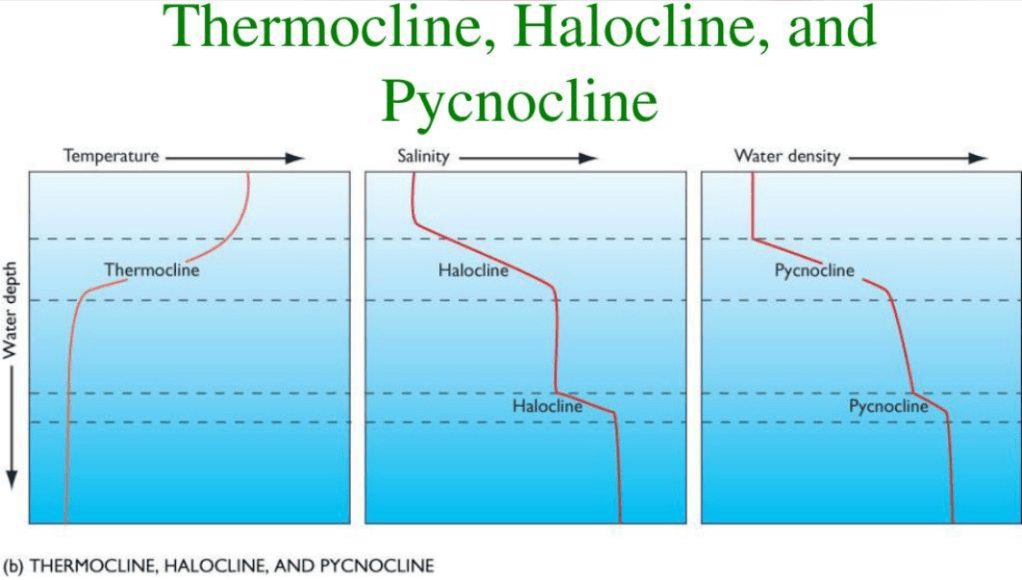
Wind-mixed layer: The upper part of the ocean where wind-driven turbulence produces relatively uniform temperature and other physical properties.
Thermocline: A region where temperature changes rapidly with depth. In many low-latitude and mid-latitude oceans, temperature decreases rapidly beneath the warm surface layer.
Pycnocline: A region where density changes rapidly with depth, often acting as a barrier to vertical mixing.
A halocline is similarly defined by a rapid change in salinity with depth.
The thermocline and halocline both contribute to density structure, although their effects can reinforce or oppose one another.
This vertical arrangement is described as stratification.
Strong stratification limits vertical mixing between the surface and deeper waters. While this helps maintain distinct water masses, it can restrict the movement of nutrients towards the sunlit surface ocean.
Seasonal changes are also important. At higher latitudes, surface cooling during autumn and winter can weaken stratification, allowing deeper vertical mixing.
I find this particularly interesting because it demonstrates that the physical structure of the ocean can directly influence biological productivity.
Research question: How does seasonal weakening of the thermocline affect nutrient availability and the timing of phytoplankton blooms in temperate oceans?
4. Wind-driven surface circulation
Why do ocean currents follow curved pathways?
The large-scale movement of surface seawater is driven primarily by winds, including the trade winds and prevailing westerlies.
Wind transfers momentum to the ocean through frictional forces at the air–sea boundary, described as wind stress.
However, ocean currents do not simply travel in the same direction as the wind.
Earth’s rotation produces the Coriolis effect, which causes moving water to be deflected to the right in the Northern Hemisphere and to the left in the Southern Hemisphere.
The strength of this effect increases with latitude and is zero at the Equator.
The interaction between wind stress, the Coriolis effect, water pressure gradients and continental boundaries produces large ocean circulation systems known as gyres.
Ekman transport
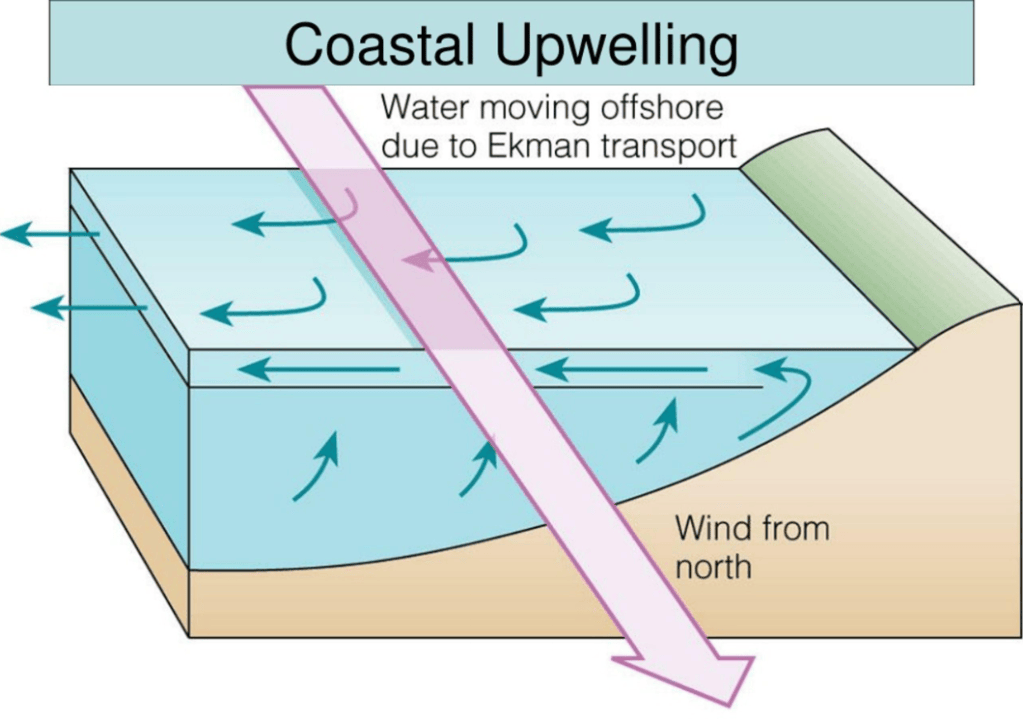
Ekman transport describes the net movement of surface-layer water resulting from the combined influence of wind stress, turbulent momentum transfer and Earth’s rotation.
In an idealised Northern Hemisphere situation, net Ekman transport occurs approximately 90° to the right of the wind direction. In the Southern Hemisphere, it occurs to the left.
The direction of individual water layers changes with depth, producing the theoretical Ekman spiral.
In reality, ocean depth, stratification, turbulent mixing and changing winds affect how clearly the spiral develops.
Question: How does the strength and persistence of prevailing winds influence the development of surface currents and ocean gyres?
5. Upwelling: Connecting physical circulation with marine ecology
One of the most ecologically significant consequences of ocean circulation is upwelling, where deeper seawater moves towards the surface.
Coastal upwelling commonly occurs when winds and Ekman transport move surface water away from a coastline. Deeper water then rises to replace it.
This deeper water is often colder and contains relatively high concentrations of dissolved nutrients, including nitrate and phosphate.
These nutrients accumulate in deeper waters partly because sinking organic material is decomposed and remineralised by microorganisms.
When nutrient-rich water reaches the sunlit surface, it can stimulate the growth of phytoplankton.
Phytoplankton are primary producers and form the foundation of many marine food webs. Consequently, regions of persistent upwelling can support substantial biological productivity and important commercial fisheries.
A useful example is the California Current system, where wind-driven upwelling supports productive marine ecosystems (NASA Earth Observatory, 2016).
However, the relationship between upwelling and productivity is not always straightforward. Light availability, nutrient ratios, grazing pressure and water residence time can all influence the ecological response.
This raises a particularly interesting question: Why are some ocean regions highly productive despite relatively cool surface temperatures, while warmer tropical waters can be comparatively nutrient-poor?
The answer is closely related to stratification and the availability of nutrients, rather than temperature alone.
6. The great ocean conveyor belt
What connects surface circulation with the deep ocean?
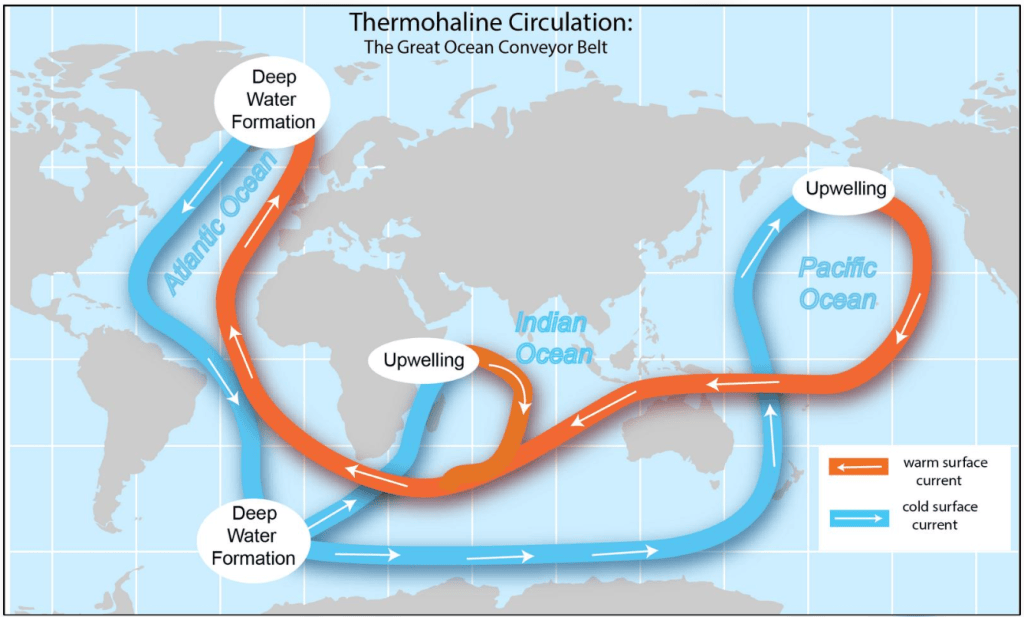
The term global ocean conveyor belt describes the interconnected movement of upper-ocean and deep-ocean water masses around the planet.
This circulation is often associated with thermohaline circulation, reflecting the influence of temperature (thermo) and salinity (haline) on seawater density.
However, the actual global overturning circulation is more complex than a single continuous conveyor belt. Winds, density differences, turbulent mixing and the geography of ocean basins all influence water movement.
North Atlantic Deep Water (NADW)
In the North Atlantic, relatively warm and saline waters move northwards through the Atlantic circulation system.
As these waters reach higher latitudes, they lose heat to the atmosphere. Cooling increases density, allowing deep convection to occur where conditions permit.
The resulting deep water contributes to the formation of North Atlantic Deep Water (NADW), which flows southwards at depth through the Atlantic Ocean.
Antarctic Bottom Water (AABW)
Deep-water formation also occurs around Antarctica.
During sea-ice formation, much of the salt is excluded from the growing ice. This process, known as brine rejection, increases the salinity and density of nearby seawater.
Under suitable conditions, dense water descends and contributes to the formation of Antarctic Bottom Water (AABW), one of the densest major water masses in the global ocean.
AABW spreads northwards into deep ocean basins and is important for deep-ocean ventilation.
How does deep water return to the surface?
Deep water does not remain permanently isolated.
Wind-driven upwelling, turbulent mixing and circulation in the Southern Ocean and Indo-Pacific contribute to the eventual return of deep water towards the surface.
These processes operate over long timescales, often spanning centuries to more than a thousand years for parts of the circulation system.
The global conveyor belt is therefore best understood as a simplified representation of interconnected ocean circulation pathways rather than a single current following one fixed route.
7. The Atlantic Meridional Overturning Circulation (AMOC)
The Atlantic Meridional Overturning Circulation (AMOC) is a major component of the global ocean circulation system.
It transports relatively warm upper-ocean waters northwards through the Atlantic and returns colder, denser water southwards at depth.
This transfers considerable quantities of heat and influences climate in the North Atlantic region and beyond.
The Gulf Stream contributes to this system, but the Gulf Stream and AMOC are not interchangeable terms. The Gulf Stream is a western boundary current influenced substantially by winds and ocean pressure gradients, whereas the AMOC describes a broader overturning circulation.
A particularly important area of investigation concerns the potential effects of increasing freshwater inputs, ocean warming and changing density gradients on the strength of the AMOC.
If surface waters in deep-water formation regions become warmer or fresher, their density may decrease, potentially reducing the formation of deep water.
However, accurately projecting future AMOC behaviour is difficult because it involves interacting oceanic and atmospheric processes.
NOAA’s State of the Science Fact Sheet: Atlantic Meridional Overturning Circulation (2024) provides a useful scientific overview of these mechanisms and uncertainties.
Questions I would like to investigate further:
- How do researchers measure the strength of the AMOC across an ocean basin?
- What evidence distinguishes natural variability from long-term circulation change?
- Could changes in the AMOC alter European rainfall patterns or marine ecosystems?
- What are the uncertainties associated with climate-model projections of future circulation?
8. Ocean circulation, nutrients and the carbon cycle
One of the most important connections emerging from this topic is the relationship between physical circulation and biological processes.
The oceans absorb carbon dioxide from the atmosphere, while marine organisms incorporate carbon into organic material through photosynthesis.
Some of this organic matter sinks into deeper waters, where decomposition returns carbon and nutrients to the water column.
This process forms part of the biological carbon pump.
The solubility carbon pump operates through the physical absorption, transport and redistribution of dissolved inorganic carbon. Cold seawater generally has a greater capacity to dissolve carbon dioxide, although the chemistry is also influenced by alkalinity and other factors.
Ocean circulation links these processes by transporting dissolved carbon and nutrients between surface and deep waters.
Upwelling can return carbon-rich and nutrient-rich water to the surface. Depending on local conditions, this may increase phytoplankton productivity, promote the release of carbon dioxide to the atmosphere, or contribute to both processes.
This illustrates why the role of ocean circulation in carbon storage cannot be understood through a single physical or biological mechanism.
It requires consideration of physics, chemistry and ecology as interacting components of the Earth system.
Reflection: What has this changed in my understanding?
Before studying this topic, I understood that ocean currents transferred warm and cold water around the planet. What I had not fully appreciated was the extent to which circulation depends on relationships between the molecular properties of water, surface winds, Earth’s rotation and differences in density.
The connection between physical oceanography and marine ecology has been particularly interesting.
The processes that produce a thermocline, for example, also influence the availability of nutrients to phytoplankton. Similarly, changes in ocean circulation can affect carbon transport, marine productivity and regional climate conditions.
What initially appeared to be several separate topics — seawater chemistry, ocean stratification, surface currents and deep-water circulation — are now beginning to form a much more connected picture.
There are still areas that I want to understand in greater depth, particularly the relationship between freshwater inputs, density and AMOC stability, and how scientists distinguish long-term changes from natural variability.
My main conclusion is that ocean circulation cannot be explained by one driving force. It is the result of numerous interacting physical processes operating over different spatial and temporal scales. Understanding these relationships is essential for interpreting the wider consequences of climate and environmental change.
References and further reading
- NASA Earth Observatory (2016). California Coastal Current.
- NOAA (n.d.). Ocean Currents.
- NOAA National Ocean Service (n.d.). Thermohaline Circulation.
- NOAA National Ocean Service (n.d.). The Global Conveyor Belt.
- Sabatello, R. (2024). State of the Science Fact Sheet: Atlantic Meridional Overturning Circulation. NOAA.
- IOC, SCOR and IAPSO (2010). The International Thermodynamic Equation of Seawater – 2010 (TEOS-10). UNESCO.
- The Open University (2026). Environmental Science, course learning materials on ocean properties, surface currents and meridional overturning circulation. Add the specific module code and study unit before publication.
- Introduction to Oceanography – Simple Book Publishing

