Field Notes:
Date: 25 April 2026
Location: Alice Holt Forest, Hampshire
Activity: Amphibian Survey – Netting, Egg Searching and Species Identification
Duration: 4 hours
Species Recorded: Palmate newt, smooth newt, common frog, frog tadpoles and toad tadpoles
Additional Observation: Water frogs heard calling nearby
Activity Overview
I spent four hours participating in an amphibian survey at Alice Holt Forest, working alongside experienced surveyors to develop my practical skills in amphibian identification and survey techniques.
This was one of my favourite conservation experiences of the month and my first opportunity to participate in a professional amphibian survey.
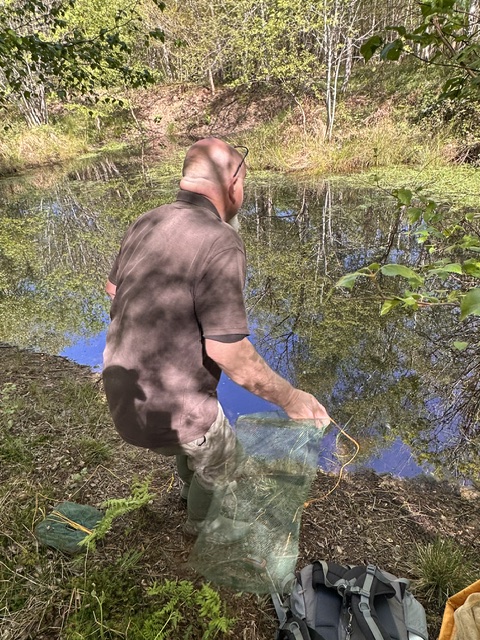
The session involved pond netting and searching for amphibian eggs, providing valuable insight into how different survey techniques can be used to identify species and investigate breeding activity.
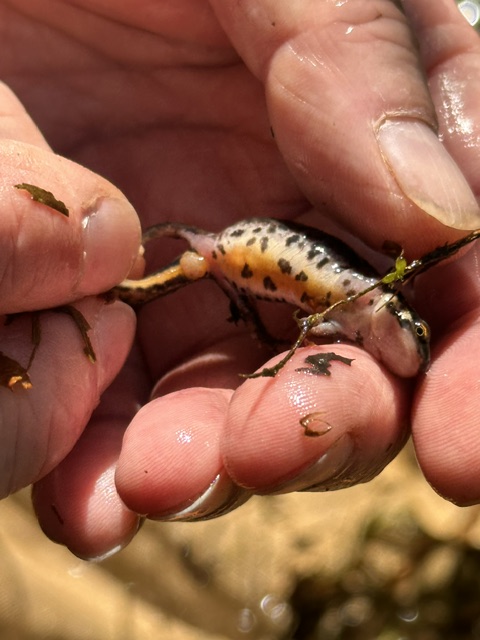
During the survey, we recorded palmate newts (Lissotriton helveticus), smooth newts (Lissotriton vulgaris), common frogs (Rana temporaria) and both frog and toad tadpoles. We could also hear water frogs calling nearby.
Working alongside experienced surveyors was particularly valuable, allowing me to observe established field techniques and develop greater confidence in identifying amphibians at different stages of their life cycle.
Species Observations
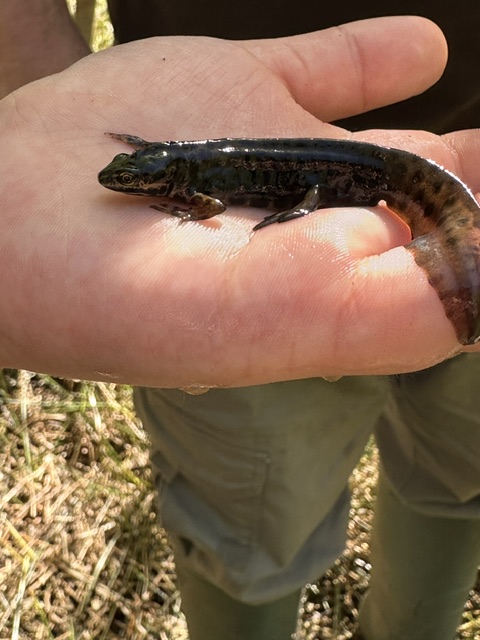
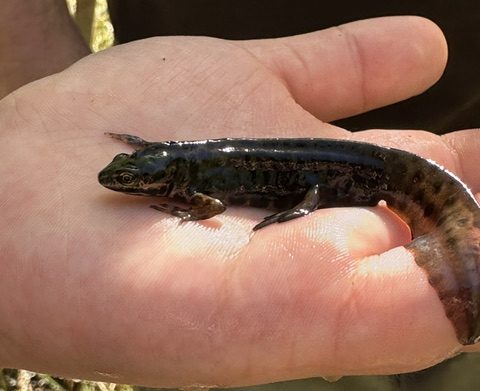
Palmate Newt (Lissotriton helveticus)
Palmate newts are small amphibians frequently associated with ponds in woodland, heathland and other habitats, often favouring relatively acidic waterbodies.
They are similar in appearance to smooth newts, making careful identification important during surveys.
Key identifying characteristics include:
- Males develop dark webbing on their hind feet during the breeding season.
- Breeding males have a short filament at the tip of the tail.
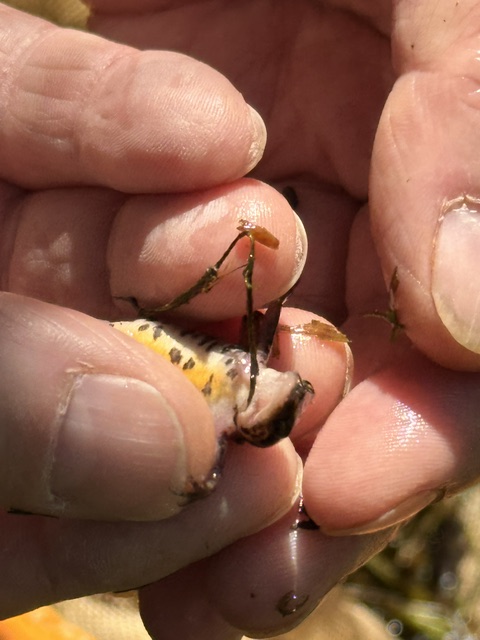
- The throat is generally unspotted, helping distinguish the species from smooth newts.
- Females are more difficult to differentiate from female smooth newts.
Palmate newts spend the breeding season in water, but outside this period they occupy terrestrial habitats, sheltering beneath logs, stones and vegetation.
Smooth Newt (Lissotriton vulgaris)
Smooth newts are among Britain’s most widespread amphibians and occur in a variety of aquatic and terrestrial habitats.
During the breeding season, males develop a distinctive wavy crest extending along the back and tail.
Identification features include:
- A spotted throat, which is useful when distinguishing smooth newts from palmate newts.
- Breeding males typically develop a prominent wavy crest.
- Males often display a spotted underside with orange colouring.
- Females are generally less conspicuously marked.
The opportunity to encounter both smooth and palmate newts during the same survey was particularly useful for improving my identification skills.
Common Frog (Rana temporaria)
Common frogs are widespread across Britain and use a range of habitats, including woodland, grassland, gardens and freshwater environments.
They typically return to ponds during late winter and early spring to breed, producing distinctive clusters of gelatinous spawn.
Their tadpoles develop in freshwater before undergoing metamorphosis into juvenile frogs.
Observing common frogs alongside amphibian larvae highlighted the different stages of the amphibian life cycle occurring within the same habitat.
Frog and Toad Tadpoles
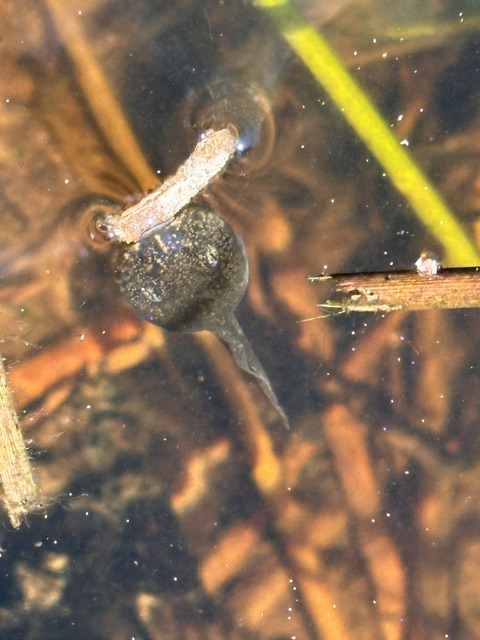
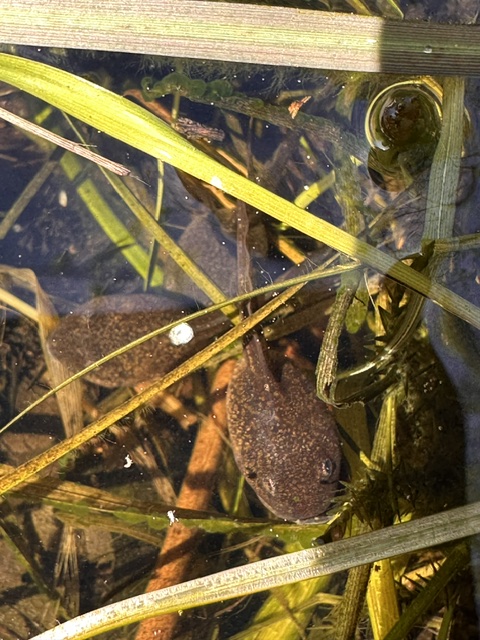
We also recorded both frog and toad tadpoles.
The differences between these two groups were particularly interesting from an identification perspective.
Common frog tadpoles are generally brown or mottled, frequently displaying golden speckling as they develop.
Common toad (Bufo bufo) tadpoles are typically darker, often appearing almost black, and may form dense groups in the water.
However, identification should consider multiple characteristics rather than relying on colour alone.
The presence of tadpoles provides evidence of amphibian breeding, although it does not necessarily establish whether individuals will survive to metamorphosis.
Water Frogs – Acoustic Observations
During the survey, we could hear water frogs calling from nearby.
Water frogs belong to the genus Pelophylax and can be distinguished from common frogs by their characteristic vocalisations and association with aquatic habitats.
Their calls were an interesting reminder that amphibian detection is not limited to visual observations.
Acoustic evidence can provide valuable information about species presence, particularly when individuals are concealed within vegetation or remain difficult to observe.
As the animals were heard rather than seen, species-level identification would require sufficient evidence to distinguish between water frog taxa.
Amphibian Survey Techniques
One of the most valuable aspects of the session was gaining practical experience with amphibian survey methods.
Pond Netting
Pond netting is used to investigate the presence of amphibians and their larvae within aquatic vegetation and other suitable areas.
The method involves carefully using a pond net to sample sections of the waterbody, allowing surveyors to examine captured organisms and identify them where possible.
Important considerations include:
- Selecting suitable sampling locations.
- Minimising disturbance to aquatic vegetation and sediment.
- Avoiding damage to eggs and other sensitive life stages.
- Carefully examining captured animals.
- Returning animals to the water promptly following identification, where appropriate.
Netting is particularly useful where water clarity or dense vegetation limits visual detection.
However, it is a relatively invasive survey technique and should be undertaken only where appropriate, with the necessary skills, permissions and safeguards.
Amphibian Egg Searching
Egg searching is another important method used to establish amphibian breeding activity.
Newts typically lay individual eggs on submerged aquatic vegetation, often folding leaves around them.
This differs from common frogs, which lay eggs in clusters, and common toads, which produce long strings of spawn.
Searching for eggs requires careful observation of aquatic vegetation and an understanding of where different species are likely to deposit them.
An important consideration is that disturbing leaves containing newt eggs can reduce their chances of successful development.
Egg searching should therefore be undertaken carefully and stopped once sufficient evidence of presence has been established, in accordance with the relevant survey protocol.
Biosecurity and Animal Welfare
Amphibian surveys require strict attention to biosecurity because infectious diseases can spread between waterbodies through contaminated equipment and footwear.
Diseases of particular concern include chytridiomycosis and ranaviral disease.
Good practice includes:
- Cleaning and appropriately disinfecting nets, trays, footwear and equipment between sites.
- Preventing the transfer of water, sediment and aquatic vegetation between waterbodies.
- Minimising unnecessary handling of animals.
- Following appropriate licensing and legal requirements, particularly where great crested newts may be present.
The experience reinforced that responsible ecological surveying must balance effective species detection with animal welfare and habitat protection.
Ecological Importance of Woodland Ponds
The survey provided an opportunity to consider the importance of freshwater habitats within woodland landscapes.
Woodland ponds can support amphibian breeding while the surrounding terrestrial habitat provides shelter, feeding opportunities and overwintering sites.
The ecological value of these ponds depends on several interacting factors, including:
- Water availability during the breeding season.
- Aquatic vegetation suitable for egg-laying.
- Availability of invertebrate prey.
- Water quality and chemistry.
- The degree of shading from surrounding trees.
- Connectivity with suitable terrestrial habitats.
- The presence and abundance of aquatic predators.
The surrounding woodland is therefore an important component of amphibian habitat.
For species such as smooth and palmate newts, conservation should consider both the aquatic breeding environment and the terrestrial habitats used during the remainder of the year.
Reflections and Learning
This was one of the most enjoyable and educational surveys I have participated in so far.
Working with experienced surveyors gave me the opportunity to develop confidence in methods that I had previously studied but had limited practical experience using.
Finding two different newt species was particularly rewarding because their similarities can make identification challenging, especially when examining females.
The observation of frog and toad tadpoles also reinforced the importance of understanding amphibian life cycles and recognising the different stages of development encountered during surveys.
Hearing water frogs calling nearby added another dimension to the experience, demonstrating that acoustic observations can complement visual and netting methods.
The activity raised several questions that I would like to explore further.
How do water chemistry and pond characteristics influence the distribution of smooth and palmate newts?
Palmate newts are frequently associated with more acidic habitats, while smooth newts occupy a broad range of pond types. Understanding the environmental factors influencing their distribution could provide useful insight into local amphibian communities.
How does woodland canopy cover affect amphibian breeding success?
Shading can influence water temperature, aquatic vegetation and primary productivity, potentially affecting larval development and habitat suitability.
How can different survey methods be combined to improve amphibian detection while minimising disturbance?
Each method has limitations, and the most appropriate approach depends on species ecology, survey objectives and environmental conditions.
Key Learning Outcomes
- Completed four hours of practical amphibian survey experience.
- Gained experience using pond netting and amphibian egg-searching techniques.
- Improved my identification knowledge of smooth and palmate newts.
- Observed common frogs and both frog and toad tadpoles.
- Recognised the value of acoustic observations through hearing water frogs calling nearby.
- Developed a greater understanding of amphibian breeding ecology and habitat requirements.
- Reinforced the importance of biosecurity and minimising disturbance during aquatic surveys.
- Increased my confidence through working alongside experienced ecological surveyors.
Final Thoughts
The amphibian survey at Alice Holt Forest was a particularly memorable experience and an important step in developing my practical ecological skills.
It was rewarding to encounter several amphibian species and life stages within the same survey, while gaining firsthand experience of techniques used by professional surveyors.
What made the session especially valuable was the opportunity to connect theoretical knowledge with practical fieldwork, particularly in relation to species identification, survey methodology and habitat assessment.
The experience increased my confidence and reinforced my growing interest in amphibian and reptile ecology.
It also highlighted the importance of combining different survey approaches to develop a more complete understanding of amphibian populations and their use of freshwater habitats.
As I continue developing my fieldwork experience, I would like to build on these skills through further amphibian surveys and gain a deeper understanding of how habitat characteristics influence species distribution and breeding success.
Photographs