Introduction
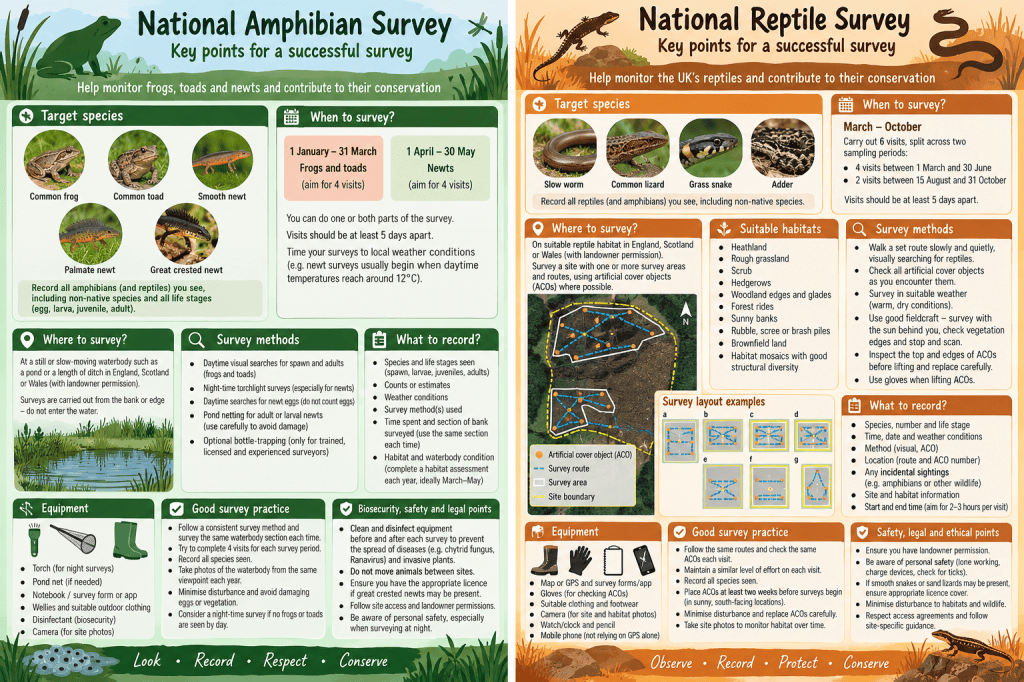
Reviewing the National Amphibian Survey Protocol and the National Reptile Survey Protocol provided a useful insight into how standardised field methods are designed to generate reliable biological data over time. Both protocols, produced as part of the National Amphibian and Reptile Monitoring Programme coordinated by Amphibian and Reptile Conservation (ARC), emphasise that biological records are most valuable when surveys are undertaken consistently, repeated at appropriate times of year and supported by clear habitat, weather and methodological information.
Although amphibians and reptiles differ in their ecology and detectability, the two protocols share several important principles. Both require surveyors to establish a repeatable survey location or route, undertake multiple visits through the active season, record all target and non-target herpetofauna observed, and submit survey results in a consistent format. These protocols demonstrate that monitoring is not simply about finding species; it is about collecting evidence in a way that makes records comparable across sites and across years.
This made me reflect on a key question:
Why is standardisation so important in ecological surveys?
The answer seems to lie in comparability. Without a repeatable approach, changes in species observations may reflect differences in survey effort rather than genuine ecological change.
What the Protocols Aim to Achieve
The National Amphibian Survey is designed to determine trends in the occurrence and relative abundance of frogs, toads and newts in the UK. It targets common frog, common toad, smooth newt, palmate newt and great crested newt, although surveyors are encouraged to record all amphibians and reptiles encountered, including non-native species.
The National Reptile Survey aims to determine trends in the occurrence and relative abundance of the widespread UK reptiles: slow worm, common lizard, grass snake and adder. As with the amphibian survey, all additional reptiles and amphibians observed should also be recorded.
In both cases, the wider purpose is conservation. Repeated monitoring allows ARC and associated organisations to investigate species distributions, assess trends over time and better understand the environmental factors influencing where species occur.
This highlighted another useful question:
How do local field observations become evidence for national conservation?
By combining records collected in a consistent way across multiple sites and multiple years, local survey data can contribute to regional and national assessments of biodiversity.
Survey Timing and Seasonal Ecology
One of the clearest lessons from both protocols is the importance of timing surveys to match species ecology.
Amphibian Survey Timing
The amphibian protocol divides the survey into two seasonal windows:
- 1 January – 31 March for frogs and toads
- 1 April – 30 May for newts
Surveyors should ideally undertake four visits for frogs and toads, and four visits for newts, with at least five days between visits. If carrying out both parts, ARC advises aiming for six or more visits in total.
This reflects the biology of amphibians. Frogs and toads are monitored during the period when they return to waterbodies to breed and produce spawn, while newt surveys are timed to coincide with peak breeding activity and detectability in ponds and ditches.
The protocol also makes it clear that local weather matters. Frog and toad activity is strongly influenced by temperature, and newt surveys should generally begin when daytime air temperature reaches around 12°C.
Reptile Survey Timing
The reptile protocol covers a broader active season, with surveys undertaken between March and October. The required six visits are split between two sampling periods:
- Four visits between 1 March and 30 June
- Two visits between 15 August and 31 October
Again, visits should ideally be separated by at least five days.
This timing reflects reptile behaviour. Reptiles are active over a longer annual period than breeding amphibians, but detectability varies according to basking conditions, season and weather.
A particularly useful point in the reptile protocol is that surveys should normally be completed in two to three hours, with route length planned so effort remains consistent and within suitable temperature conditions.
Together, the protocols reinforced a simple but important principle:
The timing of a survey must reflect the seasonal ecology and detectability of the target species.
Survey Design and Repeatability
Both protocols place strong emphasis on repeatability.
Amphibian Survey Design
The amphibian survey is based on a single waterbody, such as a pond or a ditch section, which is visited repeatedly.
Surveyors record:
- the location of the waterbody
- site and habitat details
- waterbody condition
- survey method used
- species and life-stages observed
- the amount of edge surveyed and time spent
All surveys are carried out from the bank or waterbody edge, without entering the water.
For larger ponds or ditches, only a practical section of bank may be surveyed, but it should be the same section each time.
Reptile Survey Design
The reptile survey is structured around:
- a survey site
- one or more survey areas
- one or more survey routes
- optional artificial cover objects (ACOs) placed along routes
Survey routes must be at least 100 m long, with a suggested total maximum length of 3 km across a survey.
Where possible, artificial cover objects should be placed at suitable points along the route at least two weeks before surveys begin.
This protocol illustrates how repeatability in terrestrial surveys depends not only on visiting the same site but also on following the same route and checking the same cover objects over time.
This led me to another useful reflection:
How much of ecological monitoring depends on discipline rather than simply field skill?
A great deal of it. Reliable monitoring depends on returning to the same places, at similar times and using similar levels of effort, even when the field conditions vary.
Survey Methods
One of the most interesting aspects of the protocols is how different methods reflect the ecology of the taxa being surveyed.
Amphibian Survey Methods
The amphibian survey uses one or more of the following methods:
- Daylight visual searches for frog spawn, toad spawn and amphibians
- Night-time torchlight surveys for frogs, toads and especially newts
- Daytime visual searches for newt eggs
- Pond netting for adult or larval newts
- Optional bottle-trapping only for surveyors who are trained, licensed and experienced
For frogs and toads, the protocol recommends steady visual searches for spawn clumps, spawn strings, adults, and other life stages. It also advises aiming for one night-time visit if frogs or toads are not detected by day.
For newts, the protocol explains that torchlight surveys are often the main method where water clarity is good and night access is safe. Egg searches confirm breeding, but because this method is invasive, surveyors should stop searching once eggs have been found and should never count eggs, only confirm presence. Pond netting can be helpful where visibility is poor, but it should be used carefully to minimise damage to vegetation and eggs.
Reptile Survey Methods
The reptile protocol combines two main methods:
- Visual searching
- Checking artificial cover objects
Surveyors walk slowly along established routes, visually searching for reptiles and checking ACOs as they encounter them.
The protocol emphasises good fieldcraft:
- survey with the sun behind you
- check vegetation edges and ecotones
- walk slowly and quietly
- stop and scan
- inspect the top and edges of ACOs before lifting
- use gloves when lifting cover objects
- place ACOs in south-facing locations with suitable vegetation structure and cover
I found it particularly useful that the reptile protocol recognises that successful surveying depends heavily on fieldcraft and experience, not simply on following a route.
Habitat Assessment
Both protocols also show that species records are most useful when interpreted alongside habitat information.
Amphibian Habitat Information
The amphibian protocol asks surveyors to undertake one habitat assessment each year, generally between March and May, recording features of the waterbody and surrounding habitat. The document recommends taking a photograph of the waterbody each year from the same viewpoint to provide a record of habitat change over time.
This is important because amphibian presence or absence cannot be fully understood without considering the characteristics of the breeding site.
Reptile Habitat Information
The reptile protocol places strong emphasis on identifying areas of potential reptile habitat during survey planning. Suitable habitats may include:
- heathland
- rough grassland
- scrub
- hedgerows
- allotments
- woodland edges and glades
- forest rides
- sunny banks
- rubble, scree or brash piles
- brownfield land
- habitat mosaics with structural diversity
This reminded me that habitat assessment is not an optional extra. It is a key part of ecological interpretation.
Licensing, Biosecurity and Good Practice
Another important lesson from both protocols is that surveys are not only technical tasks; they also involve professional responsibility.
Amphibians
Where great crested newts may occur, surveyors must ensure they are appropriately covered by licence arrangements. The protocol also highlights biosecurity, particularly the threat posed by chytrid fungus and Ranavirus. Clothing and equipment, especially nets and trays, should be cleaned and appropriately disinfected before and after surveys, and surveyors should also avoid spreading invasive aquatic plants.
Reptiles
For reptiles, the licensing section is especially relevant where smooth snakes or sand lizards may be present. These species require appropriate legal cover if disturbance is possible.
The reptile protocol also includes practical health and safety advice, such as telling someone where you are going if lone-working, ensuring devices are charged and checking for ticks afterwards.
Across both protocols, it is clear that ecological fieldwork must be carried out with due regard to:
- species protection law
- disease prevention
- animal welfare
- surveyor safety
- minimising disturbance
Key Learning Points
Reading these protocols has improved my understanding of several important principles of ecological field practice.
1. Monitoring relies on consistency
Standardised methods, repeat visits and repeatable locations allow records to be compared across time and space.
2. Survey methods must match species ecology
Different species require different methods because detectability varies with behaviour, breeding season, temperature, visibility and habitat structure.
3. Habitat data are essential
Species observations are much more meaningful when interpreted alongside habitat and environmental information.
4. Good fieldcraft matters
Particularly for reptile surveys, field success depends not only on the protocol itself but on observation skills, route planning and understanding where reptiles are most likely to bask or shelter.
5. Legal and ethical considerations are central
Protected species licensing, biosecurity, careful handling of habitats and attention to health and safety are not secondary details; they are fundamental to good ecological practice.
Reflections
This review made me think carefully about the relationship between survey effort and data quality.
It is tempting to think that monitoring is simply about going into the field and recording what is found, but these protocols show that the process is much more structured. The method used, the number of visits, the route chosen, the timing of the visit and the surrounding habitat all influence what is detected.
I was also struck by the way the protocols balance practical flexibility with scientific consistency. Surveyors are allowed to adapt their approach to local conditions, but they are expected to document what they do and repeat it as consistently as possible.
From a professional development perspective, the protocols reinforced that ecological surveying is both a scientific and practical discipline. It requires identification skills, habitat knowledge, observation, planning and awareness of legislation and welfare considerations.
Questions for Further Learning
Reading the protocols raised several useful questions for future study:
- How can detectability be accounted for more formally when interpreting amphibian and reptile survey data?
- How much does observer experience influence the reliability of visual reptile surveys?
- How do habitat changes between years affect the comparability of repeated surveys?
- In what ways could climate change alter the seasonal timing assumed in standard protocols?
These questions highlight that field protocols are not static rules, but tools that can also stimulate deeper ecological thinking.
Conclusion
The National Amphibian Survey and National Reptile Survey protocols provide clear examples of how field methods are designed to support robust long-term biodiversity monitoring. They show that effective ecological surveys depend on repeatability, habitat understanding, appropriate timing, good fieldcraft and responsible practice.
For me, the main lesson was that a useful biological record is not just a species name on a form. It is part of a structured process that turns field observations into evidence for conservation.
That is perhaps the most valuable insight of all: good survey work is about creating reliable evidence, not simply making observations.