Field Notes:
Date: 24 March 2026
Location: The Look Out Discovery Centre, Bracknell, Berkshire
Organisation: Chartered Institute of Ecology and Environmental Management (CIEEM)
Course: Reptiles: Ecology, Surveys and Mitigation
Tutor: Demian Lyle
Duration: 5 hours
Activity Overview
I attended a five-hour training course with CIEEM at The Look Out Discovery Centre, focusing on reptile ecology, identification, survey methodologies, habitat evaluation and mitigation techniques.
The course combined theoretical learning with practical fieldwork, exploring the ecological requirements of Britain’s native reptiles and the methods used by ecologists to survey, protect and manage their habitats.
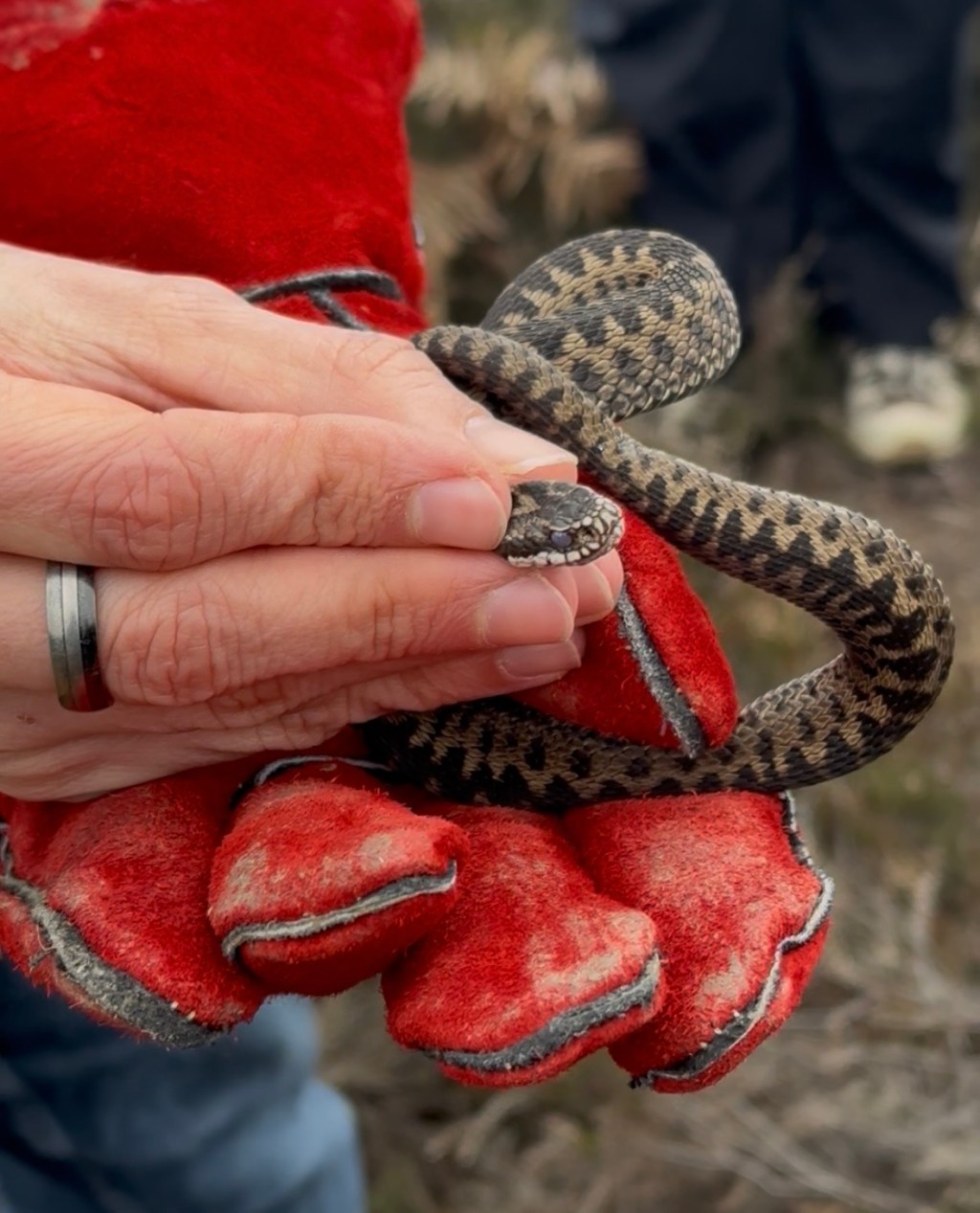
A particularly rewarding part of the day was the practical field session, during which we discovered an adder (Vipera berus) and a common lizard (Zootoca vivipara) beneath artificial refuges near the centre.
Although the identification and survey components were extremely useful, I found the sections on habitat enhancement, reptile displacement and translocation especially interesting. These demonstrated how ecological knowledge is applied to development projects and habitat management, particularly where reptile populations may be at risk.
Reptile Identification and Ecology
Britain has six native terrestrial reptile species, each with different habitat requirements, reproductive strategies and behavioural characteristics.
The course explored identifying features, breeding ecology, diet and movement patterns, all of which are relevant when planning ecological surveys.
Slow Worm (Anguis fragilis)
The slow worm is a legless lizard and is regarded as one of Britain’s most commonly encountered reptiles.
It is largely fossorial, spending much of its time beneath vegetation, within soil or under suitable cover.
Key ecological characteristics include:
- Typically produces 6–12 live young between August and September.
- Feeds predominantly on soft-bodied invertebrates, including slugs and earthworms.
- Females often have a darker dorsal stripe and contrasting flanks.
- Males are generally more uniformly coloured, occasionally displaying blue spots.
Its secretive behaviour makes artificial refuges particularly useful during surveys.
Common or Viviparous Lizard (Zootoca vivipara)
Common lizards occupy a range of habitats, including heathland, rough grassland, woodland edges and scrub.
Key characteristics include:
- Typically produces 4–10 live young between June and September, often during July.
- Feeds on small invertebrates, including insects and spiders.
- Frequently occupies relatively small home ranges, sometimes only a few tens of metres.
- Females are often more distinctly striped, while males tend to display more speckled markings.
- Males commonly have yellow or orange undersides with dark spots.
The relatively limited movement range of common lizards is important when considering habitat fragmentation and receptor site connectivity.
Grass Snake (Natrix helvetica)
Grass snakes are strongly associated with wetlands and habitats supporting amphibian populations, although they also use grassland, woodland edges and other terrestrial habitats.
- Typically lays 10–40 eggs, often within decomposing vegetation.
- Feeds mainly on amphibians, although other prey may be taken.
- Can occupy large home ranges extending hundreds of metres or several kilometres.
- Females are generally substantially larger than males.
Their dependence on suitable egg-laying sites highlights the value of compost heaps and decomposing vegetation piles as habitat features.
Adder (Vipera berus)
The adder is Britain’s only native venomous snake and is found in habitats including heathland, moorland, rough grassland and woodland edges.
- Typically gives birth to 3–18 live young between August and September.
- Feeds predominantly on small mammals, occasionally taking lizards.
- Generally avoids confrontation and will usually retreat when disturbed.
- May use communal hibernation sites, which are particularly important to identify and protect.
The importance of communal hibernation sites was an interesting ecological consideration. Disturbance or destruction of these locations can affect multiple individuals, making them particularly sensitive features during habitat management.
Sand Lizard (Lacerta agilis)
Sand lizards have a restricted distribution in Britain, primarily associated with southern heathlands and coastal dune systems.
- Lay approximately 6–14 eggs in sandy substrates, generally during May and June.
- Eggs typically hatch in late summer.
- Feed on a variety of invertebrates.
- Breeding males develop distinctive bright green colouring, particularly between late April and mid-June.
The species relies on suitable open sandy areas for egg-laying, demonstrating why the maintenance of bare ground is important within heathland management.
Smooth Snake (Coronella austriaca)
The smooth snake is one of Britain’s rarest reptiles, with populations concentrated in southern heathland habitats, particularly in Dorset, Hampshire and Surrey.
- Feeds mainly on other reptiles.
- Is relatively secretive and difficult to detect.
- Males may display orange-brown colouring along the underside and around the head and neck.
- Relies on suitable heathland vegetation structure and protective cover.
The course also briefly introduced three non-native reptiles established in parts of Britain: wall lizard (Podarcis muralis), Aesculapian snake (Zamenis longissimus) and western green lizard (Lacerta bilineata).
Recognising these species is useful to avoid misidentification during field surveys.
Practical Field Survey – Reptile Refuges
The field component involved checking artificial cover objects (ACOs) placed in suitable reptile habitat near The Look Out Discovery Centre.
During the session, we found:
1 adder (Vipera berus)
1 common lizard (Zootoca vivipara)
Finding both species beneath artificial cover demonstrated how important suitable microhabitats are for reptile thermoregulation and shelter.
Artificial cover objects, such as roofing felt or corrugated metal, are used during reptile surveys because they provide sheltered conditions that can attract reptiles.
The course also highlighted an interesting terminology distinction:
- Refuge (plural: refuges): A place providing shelter or safety.
- Refugium (plural: refugia): An area where a population survives through a period of unfavourable environmental conditions.
- Artificial Cover Object (ACO): An artificial material positioned to provide cover and facilitate reptile detection.
Although the term refugia is frequently used in reptile survey discussions, artificial refuges or ACOs are more technically appropriate for the individual survey materials.
Designing a Reptile Survey
An important part of the course involved understanding how survey design should reflect the ecological question being investigated.
For example, is the objective to:
- Establish reptile presence or likely absence?
- Estimate population size class?
- Inform a development proposal?
- Monitor an existing population or evaluate habitat management?
Survey planning should consider habitat suitability, site access, biosecurity, health and safety, survey timing and the number and distribution of artificial refuges.
The course referenced historic Froglife guidance, including approximately 5–10 refuges per hectare, at least seven survey visits for likely absence assessments and more intensive survey effort for population size-class estimates.
However, some older guidance has been superseded or withdrawn. These figures should therefore be treated as historical reference points rather than universally applicable current survey standards.
The training also recommended allowing artificial refuges at least two weeks to settle before surveys begin, ideally longer, and spreading surveys over a sufficiently long period to account for variable conditions.
The Importance of Visual Surveys
One particularly useful point was that checking artificial refuges is only part of an effective reptile survey.
Visual observation is equally important.
Common lizards and sand lizards are often detected basking in open areas close to vegetation cover rather than beneath refuges.
Recommended field techniques included:
- Moving slowly and quietly through suitable habitat.
- Keeping the sun behind the surveyor where possible.
- Carefully examining transitions between dense and open vegetation.
- Looking for basking reptiles along habitat edges.
- Recording individuals observed both beneath and away from artificial refuges.
The course emphasised that the ability to detect reptiles visually is an important skill distinguishing an experienced surveyor from someone who relies primarily on artificial cover checks.
This is something I would particularly like to develop through future practical surveys.
Evaluating Reptile Habitat
Reptiles require a variety of microhabitats to meet their ecological needs throughout the year.
The course identified several characteristics of suitable reptile habitat:
- Rough grassland, scrub, heathland and ruderal vegetation.
- A mixture of tall and short vegetation in close proximity.
- South-facing banks and warm, sheltered basking areas.
- Undulating ground creating different microclimates.
- Suitable refuges and overwintering locations.
- Egg-laying opportunities for oviparous species.
- Adequate prey availability.
- Connectivity between suitable habitat patches.
- Limited disturbance.
A central theme was the importance of maintaining a habitat mosaic rather than managing vegetation uniformly.
This is particularly relevant in heathland and grassland conservation, where both excessive scrub encroachment and over-intensive clearance can reduce habitat suitability.
Habitat Enhancement – Supporting Reptile Populations
Habitat enhancement was one of the most interesting and useful components of the training.
The course explored how habitat structure can be manipulated to improve the availability of basking sites, shelter, food resources, egg-laying sites and hibernation opportunities.
Scrub Management
Scattered scrub can provide valuable shelter and habitat structure, whereas continuous dense scrub may reduce sunlight reaching the ground.
The training discussed an indicative average of approximately 25% scattered scrub cover as a useful management target in some situations.
However, the appropriate amount depends on the reptile species, vegetation community and site-specific conservation objectives.
This reinforced the importance of habitat heterogeneity: retaining a mixture of open ground, grassland and scrub to provide different thermal and protective conditions.
Log Piles, Brash Piles and Vegetation Heaps
The creation and retention of log piles, brash piles and decomposing vegetation heaps can improve habitat complexity.
Such features may provide:
- Shelter from predators and unfavourable weather.
- Suitable microclimates for thermoregulation.
- Habitat for invertebrate prey.
- Potential overwintering opportunities.
- Egg-laying sites for grass snakes where suitable decomposing material is present.
The course also highlighted the value of relaxed grassland management, allowing tussocky vegetation and structural diversity to develop.
Artificial Hibernacula
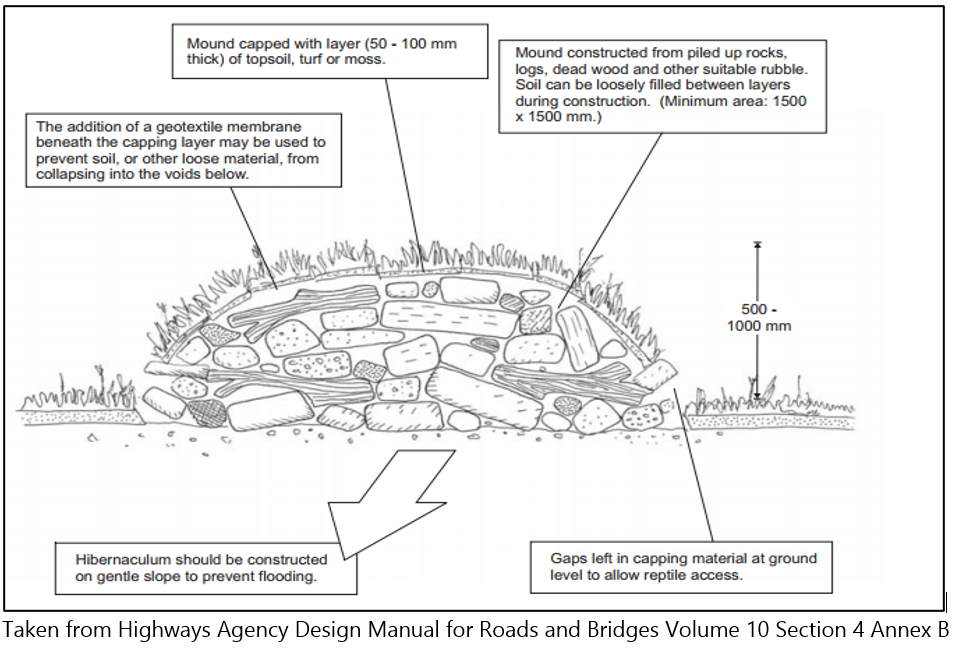
Another particularly interesting enhancement technique was the construction of artificial hibernacula.
These are structures designed to provide sheltered spaces suitable for reptiles during winter dormancy.
The training included a cross-sectional construction diagram illustrating an artificial hibernaculum constructed from rocks, logs, deadwood and rubble, with spaces between materials providing access and shelter.
The example design included:
- A mound containing loosely arranged stones, logs and other suitable materials.
- Internal cavities and gaps that remain accessible to reptiles.
- A covering of topsoil, turf or moss.
- Suitable drainage to reduce flooding risk.
- Access points at ground level.
- Positioning in an appropriate, relatively undisturbed location.
The diagram referenced a structure approximately 500–1,000 mm high, although dimensions and construction should be adapted to site conditions.
A particularly important consideration is ensuring that the hibernaculum does not become waterlogged or collapse, as this could compromise its suitability and potentially harm overwintering animals.
Habitat Connectivity
Habitat enhancement should not be limited to creating isolated features.
Connectivity between habitat patches allows reptiles to access feeding areas, basking sites, breeding habitats and overwintering refuges.
This is especially important in fragmented landscapes, where roads, development and intensive land management can restrict movement.
The course reinforced that habitat enhancements should contribute to the wider ecological functionality of a site rather than simply increasing the number of artificial habitat features.
Reptile Legislation and Legal Protection
The course covered the legal protections afforded to British reptiles, distinguishing between widespread and rarer, more highly protected species.
Widespread Reptiles
The four widespread native species are:
- Slow worm
- Common lizard
- Grass snake
- Adder
In England and Wales, these species receive protection under the Wildlife and Countryside Act 1981 (as amended), including protection against intentional killing and injury.
Rare Reptiles
Sand lizards and smooth snakes receive additional protection under the Conservation of Habitats and Species Regulations 2017 (as amended).
Relevant offences include deliberate capture, killing or injury, certain forms of disturbance, and damage or destruction of breeding sites or resting places.
These additional protections have important implications for survey methods, handling, habitat clearance and mitigation design.
Appropriate licensing requirements must be considered where activities could affect these species.
Reptile Mitigation – Avoidance, Displacement and Translocation
The course examined how mitigation strategies are selected when development or land management activities may affect reptile populations.
The starting point is the mitigation hierarchy:
Avoid → Mitigate → Compensate
Where impacts cannot be avoided, the proposed approach should reflect the reptile species present, population characteristics, habitat extent and availability of suitable alternative habitat.
Habitat Manipulation and Displacement
Habitat manipulation aims to encourage reptiles to move away from an area by gradually reducing its suitability while maintaining access to adjacent, more suitable habitat.
The course explained that this approach is generally most appropriate for smaller populations or relatively small or linear areas where suitable habitat is immediately adjacent.
The example methodology presented involved:
- An ecological fingertip search of the vegetation to be cleared.
- An initial vegetation cut to approximately 150 mm under ecological supervision.
- A further inspection and cut to ground level after at least 24 hours.
- After another interval of at least 24 hours, a supervised destructive search involving careful topsoil removal.
These were presented as example procedural stages, not a universally applicable clearance prescription. The appropriate method, timing and safeguards must be determined through site-specific ecological assessment.
A particularly important point was that displacement relies on reptiles having somewhere suitable to move.
Without appropriate adjacent habitat, vegetation manipulation alone may simply expose animals to greater risk.
Reptile Translocation
Translocation is generally considered for larger or more complex development sites, or where reptile populations cannot be adequately protected through avoidance or displacement.
The course explained the importance of preparing an appropriate receptor site before animals are captured and moved.
Key considerations include:
Receptor habitat preparation
The receiving site must provide suitable vegetation structure, prey availability, basking areas, shelter, overwintering opportunities and sufficient habitat capacity.
Reptile-proof fencing
Temporary exclusion fencing may be installed to prevent reptiles returning to areas where construction or habitat clearance will take place.
Capture and trapping effort
Artificial refuges can be used to facilitate capture, with trapping effort and duration informed by the population and relevant guidance, including Herpetofauna Groups of Britain and Ireland (HGBI) recommendations.
Clearance following capture
The training discussed clearance following an appropriate trapping programme, including a commonly referenced period of five consecutive clear trapping days before progressing to supervised habitat removal.
However, such thresholds must be considered within the context of the site, relevant guidance and an approved mitigation methodology.
Monitoring and long-term management
The ecological success of translocation depends not only on capturing and moving animals safely but also on whether they survive and persist in suitable habitat.
This was particularly interesting because translocation is sometimes viewed as a straightforward solution to development impacts.
In reality, it requires considerable planning, ecological expertise and appropriate long-term management.
Reflections and Learning
The combination of theoretical learning and fieldwork made this an extremely rewarding training experience.
Finding an adder and common lizard beneath artificial refuges provided a practical demonstration of how reptiles use the habitat and reinforced the value of carefully designed survey techniques.
However, the aspect I found most interesting was understanding how habitat enhancement and mitigation are applied in professional ecological work.
A recurring theme throughout the course was that reptile conservation requires more than identifying and recording individual animals. It requires understanding the habitat conditions needed to sustain populations over time.
The training also prompted several questions:
How can ecologists assess whether a receptor site has sufficient capacity to support translocated reptiles without negatively affecting an existing population?
What measures can be used to determine whether reptile displacement or translocation has achieved a successful long-term conservation outcome?
How can habitat management balance the need for sunny basking areas with the dense vegetation required for shelter and predator avoidance?
I was particularly interested in the artificial hibernacula designs and the practical habitat enhancement techniques discussed.
These provided tangible examples of how relatively small changes in habitat structure can support wildlife, while also demonstrating that effective management requires an understanding of species-specific ecology.
The course reinforced the value of combining visual survey skills, habitat assessment and appropriate mitigation planning when working towards conservation objectives.
Key Learning Outcomes
- Improved my identification knowledge of Britain’s six native terrestrial reptile species and three established non-native species.
- Gained practical experience checking artificial cover objects and observing an adder and common lizard.
- Developed a greater understanding of reptile ecology, reproductive strategies and habitat requirements.
- Learnt about survey design, artificial refuge deployment and the importance of visual observation.
- Improved my understanding of reptile habitat evaluation, particularly vegetation structure, connectivity and microhabitat diversity.
- Explored practical habitat enhancement measures, including scrub management, log piles, brash piles and artificial hibernacula.
- Gained an introduction to the legislative protections applying to widespread and rare British reptiles.
- Developed knowledge of reptile displacement, translocation planning and receptor site requirements.
- Recognised the importance of applying the mitigation hierarchy and evaluating long-term conservation outcomes.
Final Thoughts
The CIEEM reptile ecology, surveys and mitigation course provided an excellent introduction to the practical and technical considerations involved in reptile conservation.
Finding an adder and a common lizard during the field session was a highlight, but the most valuable learning came from understanding how ecological surveys inform habitat management and development-related mitigation.
I particularly enjoyed exploring how habitats can be enhanced through relatively simple interventions, such as scattered scrub management, creating refuges and constructing artificial hibernacula.
The discussion of reptile translocation also demonstrated the complexity of protecting populations where development cannot be avoided.
Ultimately, the course reinforced the importance of combining ecological knowledge, reliable survey techniques and evidence-based management to support the long-term conservation of reptile populations.
It was a valuable addition to my practical ecological training and provided useful preparation for future reptile survey work.
References and Further Reading
- Amphibian and Reptile Conservation (2010). Reptile Habitat Management Handbook.
- Amphibian and Reptile Conservation (2013). Survey Protocols for British Herpetofauna.
- Froglife (2015). Surveying for Reptiles.
- Froglife (1999). Advice Sheet 10: Reptile Survey.
- Gent, A.H. and Gibson, S.D. (eds.) (1998). Herpetofauna Workers’ Manual.
- Herpetofauna Groups of Britain and Ireland (HGBI). Evaluating Local Mitigation/Translocation Programmes: Maintaining Best Practice and Lawful Standards.
- Wildlife and Countryside Act 1981 (as amended).
- Conservation of Habitats and Species Regulations 2017 (as amended).
The survey effort figures and mitigation methodologies described above reflect material discussed during the course, including older guidance. They should not be treated as a substitute for current legislation, professional guidance or site-specific ecological assessment.
Photographs