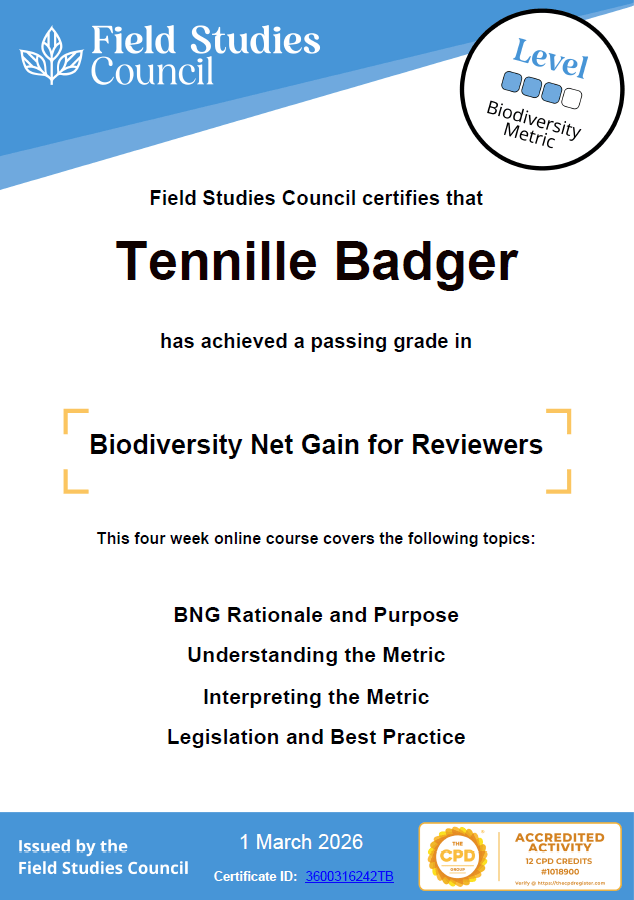
Study dates: 4 February – 9 March 2026
Professional Development: 19 hours
Training: Biodiversity Net Gain for Reviewers
Additional learning: Statutory Biodiversity Metric, planning policy, habitat assessment and ecological case studies
Introduction
Between February and March 2026, I undertook 19 hours of professional development exploring Biodiversity Net Gain (BNG), primarily through the Biodiversity Net Gain for Reviewers course, supported by webinars, technical guidance and published case studies.
The training introduced me to the relationship between ecological surveying, biodiversity measurement and the planning system. In particular, it examined how habitat information is translated into biodiversity units, how proposed improvements are evaluated and what reviewers should consider when assessing a BNG submission.
As much of my practical ecological experience has involved species identification, field surveys and habitat monitoring, I was particularly interested in understanding how this information contributes to planning decisions.
How can we measure biodiversity in a way that supports development while ensuring meaningful and lasting improvements for nature?
This question provided a useful starting point for exploring both the opportunities and limitations of Biodiversity Net Gain.
1. What Is Biodiversity Net Gain?
Biodiversity Net Gain is an approach to development that aims to leave biodiversity in a measurably better condition than it was before development.
In England, mandatory BNG was introduced through the Environment Act 2021 and associated regulations. Most qualifying developments must demonstrate a minimum 10% increase in biodiversity value, using the statutory biodiversity metric.
The underlying principle is that development should contribute positively to biodiversity rather than simply compensating for ecological damage.
However, BNG is not intended to replace existing wildlife protection legislation or the mitigation hierarchy.
The Mitigation Hierarchy
The mitigation hierarchy provides a framework for managing ecological impacts in the following order:
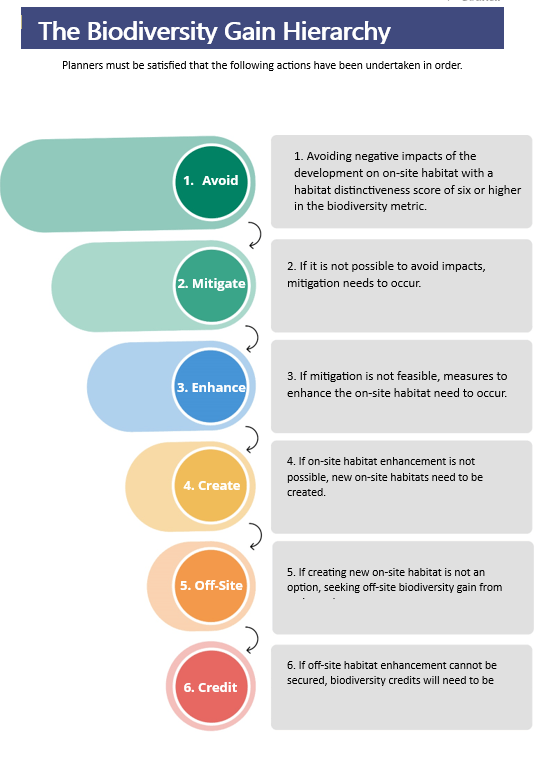
Biodiversity Net Gain should be considered alongside these principles, rather than being used to justify avoidable habitat destruction.
An important distinction is that a development achieving a 10% biodiversity gain does not automatically demonstrate that all ecological impacts have been adequately addressed.
2. Understanding the Statutory Biodiversity Metric
The statutory biodiversity metric provides a standardised method for calculating biodiversity value using habitat characteristics.
It operates as a proxy for biodiversity rather than directly measuring every species or ecological interaction within a habitat.
Three broad habitat categories are assessed separately.
| Habitat category | Measurement | Examples |
|---|---|---|
| Area habitats | Hectares | Grassland, woodland, scrub, heathland |
| Hedgerows | Kilometres | Native hedgerows and lines of trees |
| Watercourses | Kilometres | Rivers, streams, canals and ditches |
The values generated for these categories are not freely interchangeable.
Habitat Size, Condition and Distinctiveness
The course material introduced three fundamental factors affecting biodiversity unit calculations.
Habitat size describes the area or length of the habitat being assessed.
Habitat condition describes its ecological quality relative to defined assessment criteria. These may consider vegetation composition, structural diversity, disturbance and other habitat-specific characteristics.
Habitat distinctiveness reflects the relative biodiversity importance of a habitat type.
A simplified representation of the calculation is:
Habitat size × Condition × Distinctiveness = Biodiversity value
In practice, the statutory metric also considers strategic significance and applies relevant risk multipliers to habitat creation and enhancement proposals.
For example, two grassland habitats may occupy identical areas but receive different biodiversity unit scores because their condition or distinctiveness differs.
A species-rich grassland containing a varied plant community and suitable habitat structure may have substantially greater biodiversity value than intensively managed, species-poor grassland.
This illustrates why accurate habitat classification and field-based condition assessment are essential to credible biodiversity calculations.
Strategic Significance
Strategic significance considers whether a habitat is located in an area identified as ecologically important through relevant local strategies or plans.
Habitats contributing to wider ecological networks, habitat connectivity or recognised local nature recovery priorities may receive additional consideration within the metric.
This is particularly important because habitats rarely function independently.
A hedgerow, for example, may provide food and shelter while also connecting areas of woodland or grassland, enabling species to move across the landscape.
Could habitat connectivity provide greater ecological benefits than isolated habitat creation, even where both proposals generate similar biodiversity unit totals?
This is an important consideration when moving beyond numerical calculations to evaluate ecological outcomes.
3. The Role of Competency in Habitat Assessment
One of the key learning points from the BNG for Reviewers training was the importance of professional competency.
The accuracy of a biodiversity assessment depends on the knowledge and experience of the individual undertaking the habitat survey.
Competency involves demonstrating that an assessor has acquired the necessary skills through appropriate qualifications, training and practical experience.
Different habitat types may require specialist assessment methods.
For example, watercourse condition assessments require specific competencies that are not necessarily covered by general terrestrial habitat surveying experience.
The training also referred to botanical identification skills, including Field Identification Skills Certificate (FISC) Level 3, as a useful consideration when evaluating botanical assessment competency.
However, competency should be assessed in relation to the particular task and habitat involved rather than assumed from a single qualification.
This reinforced the importance of developing my own practical habitat surveying abilities alongside technical knowledge of the biodiversity metric.
4. Biodiversity Net Gain Within the Planning Process
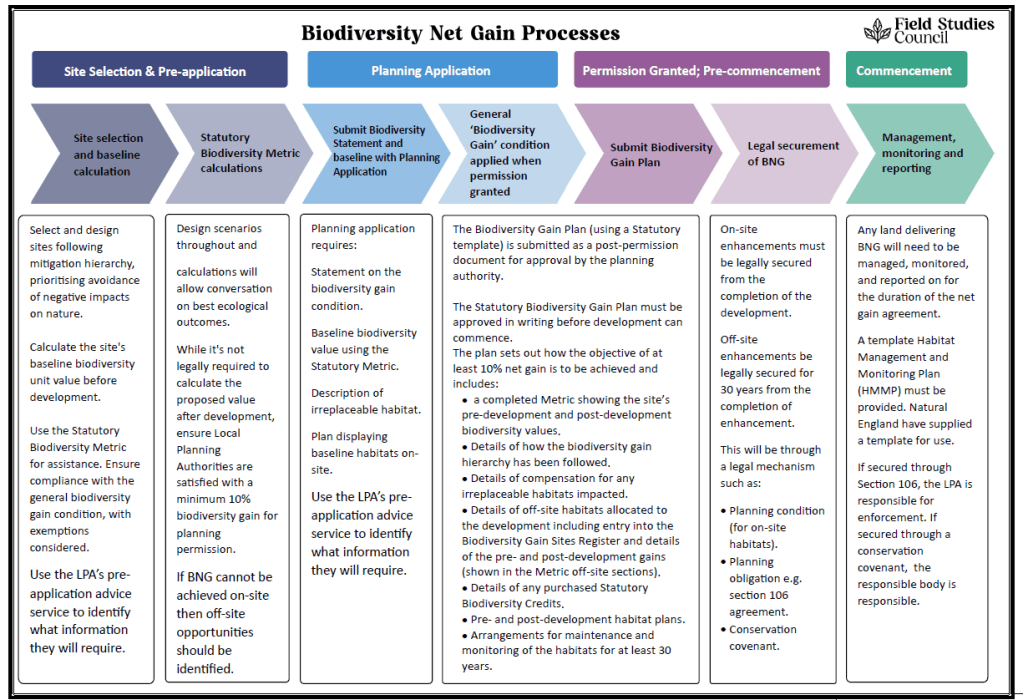
The Field Studies Council’s Biodiversity Net Gain Processes diagram provided a useful overview of how biodiversity assessment moves from early development design into planning, delivery and monitoring.
Stage 1: Site Selection and Baseline Assessment
The process begins by identifying the habitats present before development.
The baseline assessment records existing habitats and evaluates their biodiversity value using the statutory metric.
Early consideration of biodiversity can inform site selection and help developers avoid impacts on habitats of higher ecological importance.
Stage 2: Development Design and Metric Calculations
The biodiversity metric is used to explore how different development designs may affect habitat value.
Potential measures include retaining existing habitats, enhancing their condition, creating new habitats and identifying off-site opportunities where sufficient gains cannot be achieved on-site.
Considering these options early enables ecological outcomes to influence development design.
Stage 3: Planning Application
Planning applications subject to mandatory BNG must include specified biodiversity information.
This includes the relevant baseline biodiversity value and supporting habitat information.
The planning authority can use this information to consider the ecological implications of the proposed development.
Stage 4: Biodiversity Gain Plan
Once planning permission has been granted, a Biodiversity Gain Plan must ordinarily be approved before development commences, where the statutory BNG condition applies.
The plan demonstrates how the required biodiversity gain will be achieved.
It may include updated metric calculations, habitat plans, details of off-site gains and information about any statutory biodiversity credits.
Stage 5: Legal Agreements and Habitat Management
Qualifying biodiversity gains must be appropriately secured.
Depending on the circumstances, mechanisms may include planning conditions, Section 106 agreements or conservation covenants.
Significant on-site gains and registered off-site gains are subject to long-term management and maintenance requirements.
Stage 6: Monitoring and Reporting
Biodiversity Net Gain does not end when a habitat has been planted or restored.
Qualifying gains must generally be maintained for at least 30 years.
Habitat Management and Monitoring Plans (HMMPs) provide a framework for establishing management objectives, assessing habitat development and identifying corrective actions where progress differs from expectations.
This long-term requirement highlights an important distinction between habitat creation and successful ecological restoration.
Planting a woodland does not immediately establish a functioning woodland ecosystem. Structural diversity, soil processes, ecological interactions and suitable conditions for associated species may take many years to develop.
5. Reviewing Biodiversity Net Gain Submissions
The reviewer perspective was one of the most interesting aspects of the course.
Reviewing a BNG submission requires more than confirming that the biodiversity metric produces a positive numerical result.
A reviewer must critically assess the ecological evidence, calculations and management assumptions that support the proposed outcomes.
Important considerations include:
- Whether baseline habitats have been correctly identified, classified and mapped.
- Whether habitat condition assessments are supported by sufficient field evidence.
- Whether the biodiversity metric has been completed accurately.
- Whether habitat distinctiveness and strategic significance have been correctly applied.
- Whether the mitigation hierarchy has influenced development design.
- Whether proposed habitat creation and enhancement are ecologically realistic.
- Whether long-term management and monitoring arrangements are adequate.
- Whether the necessary legal arrangements will secure qualifying biodiversity gains.
For example, a development may propose creating a species-rich grassland to achieve the required biodiversity units.
However, the likelihood of success depends on several factors, including soil fertility, hydrology, seed selection, site preparation and ongoing management.
Without appropriate consideration of these factors, predicted habitat condition may be unrealistic.
Should a biodiversity gain be considered successful when the calculated target is achieved on paper, or only when monitoring demonstrates that the intended ecological condition has developed?
This question highlights the importance of ecological judgement within BNG assessments.
6. Learning from Biodiversity Net Gain Case Studies
To understand how biodiversity enhancement can be delivered in practice, I reviewed case studies published in CIRIA C776b, Biodiversity Net Gain: Good Practice Principles for Development – Part B: Case Studies (2019).
These examples pre-date the current mandatory BNG framework but provide useful insights into ecological design, stakeholder engagement and habitat restoration.
Medmerry, West Sussex – Coastal Habitat Restoration
The Medmerry scheme demonstrates how coastal management can integrate ecological restoration with wider environmental objectives.
Managed realignment provided opportunities for the establishment of coastal and intertidal habitats while contributing to improved flood risk management.
The scheme illustrates the concept of ecosystem services, whereby habitats deliver benefits such as flood protection, carbon storage, wildlife conservation and recreation.
It also raises an interesting question about the relationship between biodiversity value and broader ecosystem functions.
Although biodiversity metrics focus on habitat-related values, habitat restoration can deliver environmental benefits that extend beyond those directly captured within biodiversity units.
Kingsbrook, Aylesbury – Ecology-Led Development
The Kingsbrook residential development demonstrates how ecological considerations can influence the design of large housing schemes.
Measures described in the case study include wildlife-rich green spaces, habitat creation, ecological corridors and wildlife-sensitive design features.
The example highlights the advantages of considering biodiversity at the master-planning stage rather than attempting to address ecological impacts after major design decisions have been finalised.
An important lesson is that ecological improvements can be incorporated into a development’s wider green infrastructure network.
Priest Hill Nature Reserve, Surrey – Habitat Restoration
The Priest Hill Nature Reserve case study explores habitat restoration associated with development and partnership working.
The project involved transforming previously developed land into a nature reserve, creating opportunities for grassland restoration and improved habitat connectivity.
This example was particularly relevant to my interests because it demonstrates the importance of long-term habitat management.
Creating suitable conditions for a habitat to establish is only one part of restoration. Ongoing management is necessary to maintain ecological quality and prevent undesirable changes in vegetation structure or species composition.
Lessons from the Case Studies
Across the examples, several common themes emerged.
Successful biodiversity outcomes require early ecological involvement, collaboration between stakeholders, appropriate habitat design and a commitment to ongoing management.
The case studies also illustrate that biodiversity enhancement should be considered at a landscape scale wherever possible.
However, as the CIRIA publication is a collection of project-submitted examples rather than independently audited outcomes, the reported achievements should be interpreted within that context.
7. Local Planning Policy and Biodiversity Protection
I also reviewed the Tunbridge Wells Borough Core Strategy, adopted in June 2010, to understand how biodiversity conservation has historically been incorporated into local planning policy.
The document identifies important environmental assets, including ancient woodland, designated wildlife sites, hedgerows, landscapes and ecological corridors.
Core Policy 4 addresses the environment and recognises the importance of protecting and enhancing ecological networks.
Although the document predates mandatory BNG and should be understood in its historical planning context, it demonstrates that the relationship between development and biodiversity conservation was already recognised within local planning frameworks.
Of particular interest was the emphasis on habitat connectivity and the protection of natural landscape features.
Fragmented habitats can restrict species movement, reduce opportunities for dispersal and contribute to the isolation of populations.
Protecting and improving connections between habitats can therefore be an important component of effective conservation planning.
This has reinforced my understanding that biodiversity assessment must consider not only the condition of individual habitats but also their ecological role within the surrounding landscape.
8. Habitat Management and the Challenge of Long-Term Delivery
A recurring theme throughout the training was the distinction between predicting biodiversity gains and delivering them.
Ecological systems respond to environmental conditions, management practices and natural processes that may change over time.
For example, the success of grassland restoration can be influenced by soil nutrient availability, grazing pressure, vegetation competition and seasonal weather conditions.
Woodland creation may require longer timescales before habitat structure and ecological complexity approach the intended target.
Consequently, habitat creation and enhancement proposals must account for uncertainty.
The statutory metric incorporates risk factors relating to habitat establishment and the time required to achieve target condition.
However, these calculations cannot remove every uncertainty associated with ecological restoration.
Monitoring therefore plays a critical role in determining whether predicted outcomes are being achieved.
How should habitat management be adapted when monitoring demonstrates that the intended ecological improvements are not developing as expected?
Adaptive management provides one possible approach, using monitoring results to inform changes in management practices and improve ecological outcomes.
This is an area I would like to investigate further, particularly through practical experience of habitat management planning and long-term ecological monitoring.
9. Good Practice Principles
1. Apply the Mitigation Hierarchy
Development should prioritise avoiding impacts on biodiversity, followed by minimising unavoidable impacts. Compensation should only be considered after opportunities for avoidance and mitigation have been exhausted.
This principle reinforces the importance of considering ecological constraints during early site selection and development design.
2. Avoid Losing Biodiversity That Cannot Be Offset Elsewhere
Some habitats are irreplaceable because their ecological complexity, formation processes or development timescales mean they cannot realistically be recreated.
Ancient woodland is an example where compensatory habitat creation cannot reproduce the ecological value lost through destruction.
The principle recognises that achieving a numerical biodiversity gain does not justify the loss of irreplaceable biodiversity.
3. Be Inclusive and Equitable
Stakeholders should be involved throughout the planning, implementation and monitoring of biodiversity improvements.
This may include ecological consultants, planning authorities, landowners, conservation organisations and local communities.
Early engagement can help ensure that biodiversity improvements respond to local ecological priorities and that benefits are shared fairly.
4. Address Risks
Biodiversity enhancement involves uncertainty, particularly where newly created habitats require several years to develop.
Risks may include unsuccessful habitat establishment, inappropriate management, climate variability and delays in achieving target condition.
These uncertainties should be considered during habitat planning and biodiversity calculations, with appropriate measures introduced to improve the likelihood of successful outcomes.
5. Make a Measurable Net Gain Contribution
Biodiversity improvements should be measurable and contribute to recognised nature conservation priorities.
The statutory biodiversity metric provides a standardised method of quantifying habitat-related biodiversity value, enabling comparisons between baseline conditions and proposed development outcomes.
However, quantitative assessments should be supported by ecological evidence and professional judgement.
6. Achieve the Best Outcomes for Biodiversity
Biodiversity enhancement should focus on delivering the most appropriate ecological outcomes rather than simply maximising the number of biodiversity units.
This includes considering habitat connectivity, local conservation priorities, ecological resilience and opportunities to improve existing habitats.
For example, restoring a degraded grassland adjacent to an existing nature reserve may provide greater ecological connectivity than creating an isolated habitat elsewhere.
7. Be Additional
Biodiversity gains should represent improvements beyond what would otherwise have occurred.
This means that proposed gains should not simply reflect measures already required or outcomes that would have happened without the development-related biodiversity initiative.
The concept of additionality is important because it helps distinguish genuine ecological improvements from activities that do not provide an additional conservation benefit.
8. Create a Net Gain Legacy
Biodiversity enhancement should deliver long-term benefits rather than short-lived improvements.
This requires appropriate financial arrangements, legal commitments, management responsibilities and monitoring.
Under England’s mandatory BNG framework, qualifying habitat gains generally need to be maintained for at least 30 years.
However, the broader good practice principle encourages biodiversity improvements that remain valuable beyond the minimum management period.
9. Optimise Sustainability
Biodiversity Net Gain should contribute to wider environmental, social and economic sustainability objectives wherever possible.
Habitat restoration may deliver additional ecosystem services, including flood regulation, carbon storage, water quality improvements and recreational opportunities.
The Medmerry coastal restoration scheme provides an example of how biodiversity improvements can be integrated with wider environmental objectives.
10. Be Transparent
The assumptions, calculations, decisions and outcomes associated with biodiversity enhancement should be communicated clearly.
Transparent reporting enables stakeholders to understand how biodiversity values have been assessed, which management measures are proposed and whether expected improvements have been achieved.
This principle is particularly relevant to the role of BNG reviewers, who must evaluate the ecological evidence and technical assumptions supporting a development proposal.
Reflection: Why Do These Principles Matter?
Examining the ten principles has helped me understand that Biodiversity Net Gain is more than a statutory requirement to achieve a 10% increase in biodiversity value.
Although the biodiversity metric provides a consistent approach to calculating habitat-related changes, the principles establish a wider framework for responsible ecological decision-making.
I was particularly interested in the concepts of additionality, irreplaceable biodiversity and long-term ecological legacy.
These raise an important question:
Can a development be considered environmentally successful if it achieves its required biodiversity units but fails to provide meaningful, resilient and lasting ecological improvements?
For me, these principles reinforce the importance of considering ecological function, habitat connectivity and long-term management alongside numerical assessments.
As I continue developing my habitat surveying and ecological assessment skills, I would like to explore how these principles are incorporated into real planning applications and how reviewers determine whether proposed biodiversity gains are both credible and achievable.
Reference
CIEEM, CIRIA and IEMA (2016) Biodiversity Net Gain: Good Practice Principles for Development.
CIRIA (2019) Biodiversity Net Gain: Good Practice Principles for Development. A Practical Guide. C776a.
10. Personal Reflection
Studying Biodiversity Net Gain has helped me develop a more integrated understanding of the relationship between ecology, land management and the planning system.
My practical ecological experience has primarily involved field surveying, identifying species, recording habitat characteristics and participating in conservation activities.
The BNG training demonstrated how this information can contribute to the wider process of assessing development proposals and designing ecological improvements.
I found the application of the statutory biodiversity metric particularly interesting because it attempts to translate complex ecological characteristics into a consistent numerical framework.
However, the more I examined the process, the more I recognised the importance of understanding the limitations of quantitative assessment.
Biodiversity involves interactions between species, habitats and environmental processes that cannot be fully represented through a single calculation.
The metric therefore provides an important decision-support tool, but its results must be interpreted alongside sound ecological evidence and professional judgement.
The CIRIA case studies strengthened this understanding by illustrating the importance of ecological design, stakeholder collaboration and long-term habitat management.
Reviewing historical local planning policy also helped me appreciate how biodiversity protection has evolved and how contemporary BNG requirements build upon broader principles of habitat conservation and ecological connectivity.
My next objective is to develop practical experience of UK Habitat Classification (UKHab), habitat condition assessments, statutory biodiversity metric calculations and Habitat Management and Monitoring Plans.
I would also like to gain experience reviewing real development submissions to better understand how ecological evidence is evaluated within the planning process.
Ultimately, this learning has strengthened my interest in ecological consultancy, particularly the opportunity to combine field-based ecological knowledge with habitat restoration, environmental planning and evidence-based decision-making.
The central lesson I have taken from this training is that successful Biodiversity Net Gain must be measured not only by what a development promises to deliver, but by the ecological outcomes that are established and maintained over time.
References and Further Reading
Butterworth, T., Baker, J. and Hoskin, R. (2019) Biodiversity Net Gain: Good Practice Principles for Development. Part B: Case Studies. CIRIA C776b.
Field Studies Council (n.d.) Biodiversity Net Gain Processes. Course guidance.
Hutchison, J. (n.d.) Biodiversity Net Gain for Reviewers. Training materials and personal course notes.
Tunbridge Wells Borough Council (2010) Core Strategy Development Plan Document. Adopted June 2010.
UK Government (2024 onwards) Statutory Biodiversity Metric and Biodiversity Net Gain Guidance. Available at: https://www.gov.uk/guidance/understanding-biodiversity-net-gain
Environment Act 2021, c.30.
Note: The 2010 planning strategy and 2019 case studies are used to illustrate the historical development and practical application of biodiversity enhancement. Current statutory and local planning requirements should be consulted for live BNG assessments.