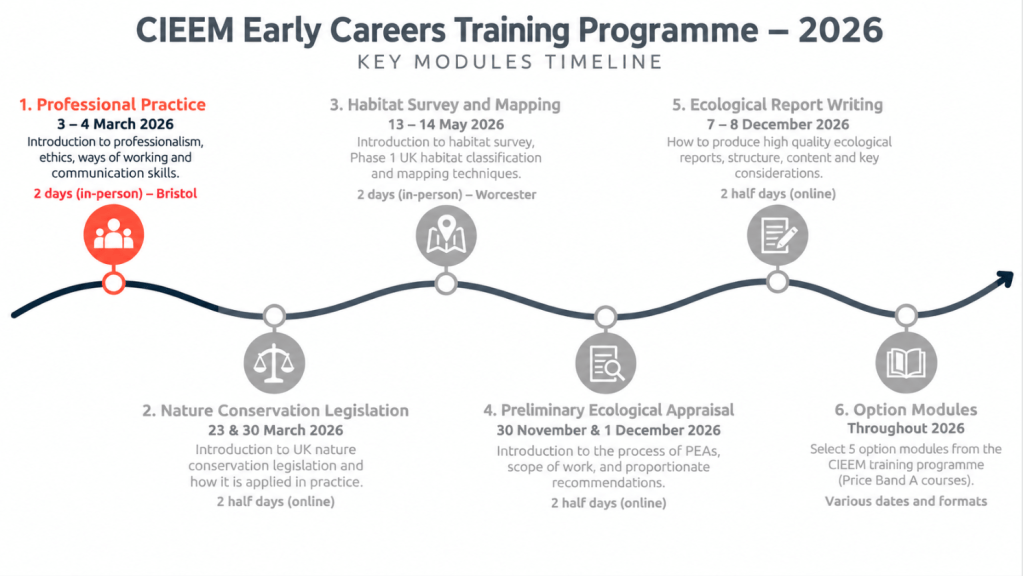
Dates: 3–4 March 2026
Location: Future Inn Bristol, Bristol
Organisation: Chartered Institute of Ecology and Environmental Management (CIEEM)
Course: Introduction to Effective Professional Ecology and Environmental Management
Training Provider: Sue Bell CEcol CEnv FCIEEM, Sue Bell Ecology
Programme: CIEEM Early Careers Training Programme
Introduction
On 3–4 March 2026, I travelled to Bristol to attend the first core module of CIEEM’s Early Careers Training Programme, Introduction to Effective Professional Ecology and Environmental Management.
As someone transitioning into ecology from an established career in project and programme management, this was an important step in developing my understanding of the profession.
The two-day course provided an introduction to the professional responsibilities, competencies, ethical principles and working practices expected of ecologists and environmental managers.
It was a great introduction to the field of professional ecology, not only because of the course content but also because of the opportunity to meet interesting people from different backgrounds who shared a passion for the natural environment.
One of the aspects I enjoyed most was being surrounded by people at different stages of their ecological careers. It was encouraging to hear about their experiences, interests and routes into the profession.
The course also helped me recognise that, although I am still developing my technical ecological knowledge, many of the professional skills I have gained throughout my previous career are transferable.
What Does It Mean to Be a Professional Ecologist?
One of the central themes of the course was understanding professionalism and how it applies to ecology and environmental management.
Professionalism extends beyond having qualifications or being knowledgeable about species and habitats. It involves demonstrating competence, exercising appropriate judgement, acting ethically and taking responsibility for the quality and consequences of one’s work.
For ecologists, this is especially important because professional decisions can directly influence biodiversity, development proposals, habitat management and the protection of legally protected species.
The course explored the relationship between ethics and professionalism, prompting me to consider an important question:
What distinguishes someone who has ecological knowledge from someone who is competent to provide professional ecological advice?
I came to appreciate that ecological knowledge is only one part of professional competence. An ecologist must also understand the limitations of available evidence, recognise when specialist input is required and communicate findings accurately and objectively.
This is particularly relevant in ecological consultancy, where recommendations may have environmental, financial and legal implications.
The CIEEM Code of Professional Conduct
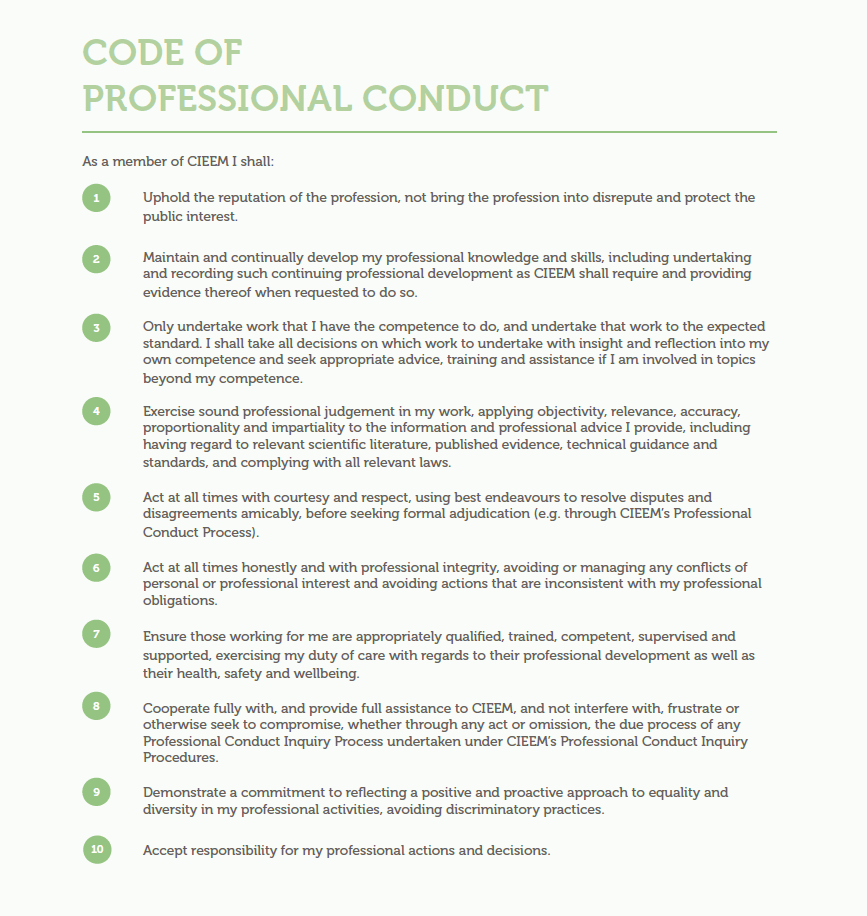
An important part of the course was an introduction to CIEEM’s Code of Professional Conduct (April 2025).
The Code establishes the standards of professional behaviour and integrity expected of CIEEM members.
Professional Integrity and Objectivity
Ecologists have a responsibility to provide accurate, impartial and evidence-based advice.
This means ensuring that ecological findings are not influenced inappropriately by commercial pressures, personal interests or the expectations of clients.
For example, where survey findings identify ecological constraints on a proposed development, a professional ecologist must communicate those findings honestly, even where the recommendations may be inconvenient or costly.
This raised an important question:
How should an ecologist respond when professional ecological advice conflicts with a client’s preferred outcome?
The Code reinforces the importance of exercising sound professional judgement, maintaining integrity and ensuring recommendations are based on relevant scientific evidence, legislation and recognised guidance.
Recognising the Limits of Competence
Another principle that resonated with me was the responsibility to undertake only work for which one is appropriately competent.
In ecology, gaining a qualification or attending a training course does not automatically establish competence to undertake specialist surveys independently.
Competence develops through a combination of knowledge, practical experience, appropriate supervision and demonstrated ability.
This is particularly important when surveying protected species, where insufficient experience can result in unreliable findings, unnecessary disturbance or breaches of wildlife legislation.
I found this especially relevant to my own career development. Although I have gained experience through volunteering and training, I recognise the importance of continuing to work alongside experienced ecologists while developing specialist skills.
Continuing Professional Development
The Code also places considerable emphasis on maintaining and developing professional knowledge and skills through Continuing Professional Development (CPD).
Ecological practice continues to evolve as scientific understanding develops, legislation changes and new survey methods become available.
For me, this reinforces the value of maintaining a structured record of training, practical fieldwork and learning experiences.
My field notes and learning journals are becoming an important part of this process, allowing me to document not only the activities I undertake but also the knowledge and competencies I develop.
Understanding the CIEEM Competency Framework
One of the most useful resources introduced through the course was the CIEEM Competency Framework.
The framework provides a structured approach to assessing professional knowledge, skills and experience across technical and transferable competency areas.
It identifies four levels of competence:
Foundation: An understanding of terminology, concepts and basic practical application, with work generally undertaken under supervision.
Capable: The ability to undertake standard tasks independently to the required professional standard, seeking advice for more complex situations.
Proficient: The experience and knowledge required to undertake complex or specialist tasks and provide guidance to others.
Authoritative: Recognised expertise, including the ability to contribute to professional practice and standards.
The framework covers 14 competency themes, including surveying, environmental management, environmental assessment, scientific methods, professional standards, health and safety, communication, project management and information management.
Applying the Framework to My Career Development
I found the framework particularly useful because it provides a way of evaluating existing skills alongside those that still need to be developed.
My background in project and programme management has given me extensive experience in planning, stakeholder engagement, communication, risk management, governance and project delivery.
These are all relevant transferable skills within ecological consultancy.
However, my technical ecological competencies are at an earlier stage of development.
For example, I am building practical experience in:
- Species identification and ecological surveying.
- Habitat assessment and management.
- Protected species ecology.
- Biological recording and data interpretation.
- Ecological legislation and survey guidance.
- Biodiversity assessment and conservation planning.
This distinction helped me recognise that changing careers does not necessarily mean starting entirely from the beginning.
Instead, it involves building new specialist competencies while applying existing professional experience in a different context.
Protected Species Surveying and Professional Competence
The supporting CIEEM competency documents for bats, badgers, hazel dormice and great crested newts provide useful examples of how professional competence is applied to particular species groups.
These documents identify the knowledge, skills and experience considered necessary to undertake specialist surveys competently.
Although each species requires different survey methods, several common themes emerge.
Understanding Species Ecology
Surveyors must understand the ecology, behaviour, habitat requirements and seasonal activity of the target species.
For example, bat surveyors need knowledge of roosting ecology, echolocation and seasonal activity, while dormouse surveyors require an understanding of suitable habitats, nesting behaviour and recognised field signs.
Applying Appropriate Survey Methods
Ecologists must understand not only how survey methods work but also their limitations.
A lack of observations does not necessarily demonstrate that a species is absent.
Survey timing, environmental conditions, observer experience and habitat characteristics can all influence detectability.
Legislation and Licensing
Protected species surveys may require specific licences, depending on the species and methods being used.
For example, activities involving disturbance of bats, checking occupied dormouse boxes or undertaking certain great crested newt surveys may require appropriate licensing.
An important distinction is that professional competence and legal authorisation are related but separate requirements.
Holding a licence does not remove the need to undertake surveys competently, while completing training does not automatically confer permission to undertake licensable activities.
Developing Specialist Experience
These documents reinforced the importance of building experience gradually through supervised fieldwork, training and appropriate mentoring.
For someone at the beginning of an ecological career, they provide a useful reference for identifying the experience required before undertaking specialist work independently.
They also highlight the value of keeping accurate records of survey participation, methods used and competencies developed.
Professional Judgement and Challenging Situations
The course explored how legislation, professional guidance and ethical responsibilities influence ecological decision-making.
Through presentations, discussion and group-based case studies, we considered the importance of applying professional judgement to challenging situations.
I found this particularly interesting because ecology often involves balancing competing considerations.
For example, development proposals may need to balance infrastructure requirements, environmental protection, legal obligations and practical mitigation measures.
Professional judgement involves evaluating the available evidence, recognising uncertainty and selecting an appropriate course of action.
This prompted another question:
How can ecologists make defensible decisions when ecological evidence is incomplete or uncertain?
One important consideration is transparency.
Professional recommendations should explain the evidence used, identify relevant limitations and clearly distinguish observed findings from assumptions or professional interpretation.
This approach helps ensure that decisions can be understood, reviewed and justified.
Communication, Inclusion and Safe Working
The course also explored professional communication and appropriate working practices.
Effective communication is essential in ecology because technical findings must often be explained to people without specialist ecological knowledge.
These may include clients, developers, landowners, planning officers, contractors and members of the public.
An ecologist must therefore be able to adapt their communication while maintaining scientific accuracy.
The course also addressed inclusive working practices, avoiding discrimination, making reasonable adjustments and recognising health and safety responsibilities.
These topics reinforced the importance of creating professional environments where individuals are treated respectfully and can contribute effectively.
My previous career has involved working with a wide range of stakeholders, so this was an area where I could recognise the relevance of my existing experience.
However, communicating ecological uncertainty, legal constraints and conservation recommendations presents new challenges that I am keen to develop my skills in.
Meeting People and Learning About the Profession
One of the highlights of the two days was meeting other people interested in ecology and environmental management.
The programme included opportunities for group discussions, collaborative learning and networking, along with evening guest speakers and an informal dinner.
The second day also included opportunities to hear from guest professionals about working within the sector.
I particularly enjoyed meeting people from different backgrounds and learning more about the variety of roles and opportunities within ecology.
Coming into a new profession can sometimes feel daunting, particularly when there is so much technical knowledge to develop.
However, speaking to others who shared a genuine interest in wildlife and the natural environment made the experience both enjoyable and encouraging.
It was also a reminder that ecological careers are not necessarily linear. People enter the sector with different experiences, qualifications, interests and professional backgrounds.
I left the course feeling more connected to the ecological community and motivated to continue developing my knowledge and practical experience.
Reflections and Learning
Looking back on the two days, I think the most valuable aspect of the course was the broader understanding it gave me of what being a professional ecologist involves.
Before attending, much of my focus had been on developing practical survey skills, improving species identification and gaining field experience.
While these remain important, the course demonstrated that professional ecology involves much more.
It requires sound scientific judgement, ethical responsibility, effective communication and a willingness to recognise one’s limitations.
It also requires a commitment to ongoing learning.
I was particularly encouraged by the CIEEM Competency Framework because it provided a structured way to assess my professional development.
Rather than viewing ecology as an entirely new career, I began to see how my existing project management skills could complement the ecological competencies I am developing.
The experience reinforced three important ideas:
1. Competence develops through experience, not simply qualifications.
Training provides an essential foundation, but practical experience, supervision and reflective learning are equally important.
2. Professional integrity is fundamental to ecological practice.
Ecologists have a responsibility to provide accurate, objective and evidence-based advice, particularly where decisions may affect biodiversity.
3. Building professional relationships is an important part of career development.
Meeting people with different experiences and specialisms provides opportunities to learn, exchange ideas and gain a better understanding of the profession.
Key Learning Outcomes
The course helped me to:
- Develop a clearer understanding of professionalism within ecology and environmental management.
- Become familiar with CIEEM’s Code of Professional Conduct and its underlying ethical principles.
- Understand how the CIEEM Competency Framework can support professional development.
- Recognise the distinction between technical knowledge, practical experience and demonstrated competence.
- Appreciate the importance of professional judgement, objectivity and evidence-based decision-making.
- Develop my understanding of appropriate communication, inclusive working practices and health and safety responsibilities.
- Identify transferable skills from my previous career that are relevant to ecological consultancy.
- Gain insight into different career pathways and build connections with people working in or entering the profession.
Final Thoughts
Attending CIEEM’s Early Careers Training Programme in Bristol was a rewarding introduction to the professional world of ecology.
The course provided much more than an overview of professional standards. It helped me understand the responsibilities associated with ecological work and the importance of developing the knowledge, practical skills and professional judgement required to undertake it competently.
Perhaps most importantly, it gave me the opportunity to meet some interesting people, exchange experiences and feel part of a community working towards a shared interest in the natural environment.
As I continue studying environmental science and building my practical field experience, I hope to develop the technical competencies needed to work confidently within ecological consultancy.
The course also reinforced that my existing professional experience remains valuable, particularly in project delivery, communication and stakeholder management.
It was an encouraging and enjoyable two days and an important milestone in my journey towards becoming a professional ecologist.
References and Further Reading
Chartered Institute of Ecology and Environmental Management (CIEEM) (2025). Code of Professional Conduct. April 2025.
Chartered Institute of Ecology and Environmental Management (CIEEM) (2024). Competency Framework.
Chartered Institute of Ecology and Environmental Management (CIEEM) (2026). Introduction to Effective Professional Ecology and Environmental Management: Early Careers Training Programme. Bristol, 3–4 March 2026.
CIEEM (2013). Competencies for Species Survey: Bats. Technical Guidance Series.
CIEEM (2013). Competencies for Species Survey: Badger. Technical Guidance Series.
CIEEM (2013). Competencies for Species Survey: Hazel Dormouse. Technical Guidance Series.
CIEEM (2013). Competencies for Species Survey: Great Crested Newt. Technical Guidance Series.
The specialist species documents are supporting reading rather than a record of individual species-survey sessions undertaken during the course. Their legislative references should be checked against current requirements before professional use.

