Date: 12 January 2026
Location: Hampton Estate, Surrey
Organisation: Surrey Wildlife Trust
Activity: Practical Habitat Management – Hedge Laying
Duration: 3 hours
Activity Overview
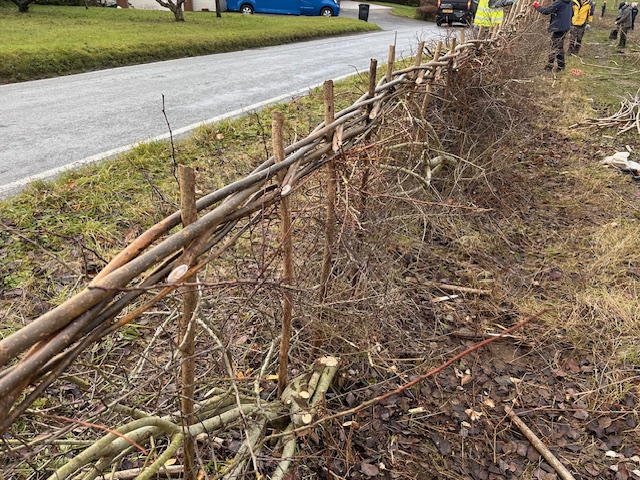
I joined Surrey Wildlife Trust volunteers at Hampton Estate for a three-hour practical conservation session focused on traditional hedge laying. The activity provided an opportunity to learn a centuries-old countryside management technique that continues to play an important role in maintaining healthy, structurally diverse hedgerows.
During the session, I was introduced to the techniques of pleaching, staking and binding, which are used together to create a dense, living hedge. Although traditionally developed to provide stock-proof boundaries for agricultural land, hedge laying also offers significant ecological benefits by creating valuable habitats and maintaining wildlife corridors across the landscape.
What Is Hedge Laying and Why Is It Important?
Hedge laying is a traditional method of managing established hedgerows by partially cutting through the stems of woody plants and carefully bending them over while keeping them attached to their roots. This encourages new growth from the base of the hedge, creating a denser and more structurally complex boundary.
The process involves three principal techniques:
- Pleaching: Partially cutting through the stem of a tree or shrub, leaving sufficient living tissue intact to maintain the connection between the roots and the upper branches. The stem is then laid at an angle along the hedge line.
- Staking: Driving wooden stakes into the ground at regular intervals to provide structural support and hold the laid stems in position.
- Binding: Weaving flexible branches, traditionally hazel, around the tops of the stakes to secure and strengthen the hedge.
Together, these techniques help rejuvenate ageing hedgerows, encourage new growth and maintain their long-term structure.
Ecological Importance of Hedgerows
Hedgerows are important features of the British countryside, supporting biodiversity within agricultural and rural landscapes. They provide food, shelter, nesting opportunities and routes for wildlife movement.
A well-managed hedgerow can support a wide range of species, including:
- Birds: Species such as dunnock (Prunella modularis), robin (Erithacus rubecula) and yellowhammer (Emberiza citrinella) use hedgerows for nesting, shelter and feeding.
- Small mammals: Wood mice (Apodemus sylvaticus) and bank voles (Myodes glareolus) use dense vegetation for protection and movement.
- Bats: Many bat species use hedgerows as linear landscape features for navigation and foraging.
- Invertebrates: Flowering and fruiting shrubs provide resources for pollinators and other insects, while the vegetation supports a variety of invertebrate communities.
Hedgerows also contribute to habitat connectivity, enabling wildlife to move between otherwise isolated woodland, grassland and scrub habitats.
This connectivity is particularly important in fragmented landscapes, where roads, agricultural fields and urban development can restrict species movement.
Reflections and Learning
One of the most valuable aspects of the session was understanding how traditional countryside management practices can support modern biodiversity conservation.
Before learning the technique, I had not fully appreciated the importance of maintaining the living structure of a hedge rather than simply cutting it back. Hedge laying encourages regeneration from the base, helping prevent gaps from developing and creating a more continuous habitat.
The practical work also highlighted the skill involved in managing living vegetation. Pleaching requires careful cutting to retain the connection between the stem and its root system, while staking and binding provide the structural support needed for the hedge to establish its new form.
The experience raised an interesting ecological question:
How does the structural complexity of a hedgerow influence the diversity and abundance of wildlife it supports?
A dense hedge with varied vegetation heights, flowering shrubs and associated ground vegetation is likely to provide a greater range of ecological niches than a regularly flailed, uniform hedge. However, its biodiversity value also depends on factors such as plant species composition, surrounding habitat and management frequency.
Key Learning Outcomes
- Gained practical experience in traditional hedge laying, including pleaching, staking and binding.
- Developed an understanding of how hedge laying encourages regeneration and improves hedgerow structure.
- Recognised the importance of hedgerows as wildlife habitats and ecological corridors.
- Explored the relationship between traditional land management practices and contemporary biodiversity conservation.
- Improved my understanding of how habitat connectivity contributes to ecological resilience in fragmented landscapes.
Final Thoughts
The session at Hampton Estate demonstrated how traditional countryside skills remain relevant to modern conservation management. Hedge laying is more than a method of maintaining field boundaries; it is a practical way of rejuvenating living habitats and supporting biodiversity across the landscape.
It was particularly rewarding to see how a relatively simple management technique, refined over generations, can contribute to wildlife conservation.
The experience reinforced the importance of combining traditional ecological knowledge with contemporary conservation science to create landscapes that support both wildlife and sustainable land management.

