Field Notes:
Date: 5 January 2026
Location: Elstead Common, Surrey
Organisation: Surrey Wildlife Trust
Activity: Practical Habitat Management – Scrub Clearance
Duration: 3 hours
Activity Overview
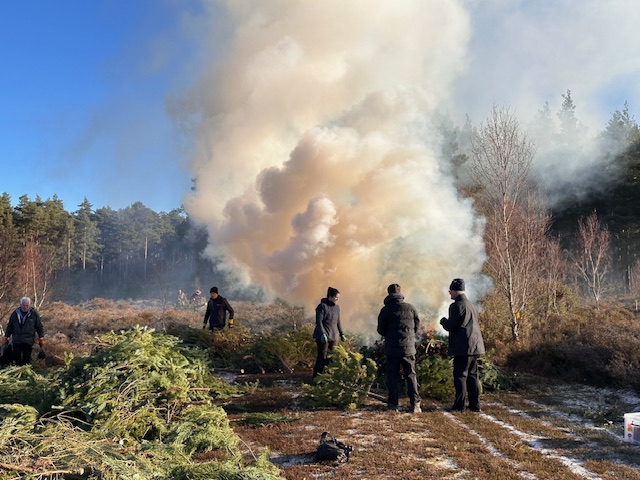
My first practical conservation activity of 2026 took place at Elstead Common, where I joined Surrey Wildlife Trust volunteers for three hours of scrub clearance. The primary objective was to maintain and restore areas of open heathland by removing encroaching pine and other woody vegetation.
Although physically demanding, the session provided valuable insight into the importance of active habitat management and how practical conservation work can contribute to maintaining biodiversity.
Why Is Scrub Clearance Important?
Lowland heathland is a rare and ecologically important habitat in the UK, characterised by nutrient-poor, acidic soils and vegetation dominated by heather, gorse and other specialist plant species.
Without appropriate management, heathland can gradually undergo ecological succession, whereby grasses, scrub and eventually woodland replace the open habitat. Pine and other woody species can accelerate this process by shading out heathland vegetation and altering habitat structure.
Scrub clearance helps maintain the open conditions and varied vegetation structure required by several conservation-priority species, including:
- Dartford warbler (Curruca undata) – associated with structurally diverse heathland containing mature heather and gorse.
- Nightjar (Caprimulgus europaeus) – a ground-nesting bird that favours open heathland and woodland clearings.
- Woodlark (Lullula arborea) – requires areas of short vegetation and exposed ground for feeding and nesting.
- Sand lizard (Lacerta agilis) – depends on sunny, open habitats with suitable vegetation cover and bare sandy areas for egg-laying.
- Adder (Vipera berus) – benefits from a mosaic of open basking areas and denser vegetation providing shelter.
Importantly, effective heathland management does not involve removing all scrub. Retaining a mosaic of vegetation heights, ages and structures supports a wider range of species and ecological functions.
Reflections and Learning
One of the most interesting aspects of the activity was recognising that conservation is not always about allowing vegetation to grow undisturbed. In certain habitats, particularly those historically maintained through grazing, cutting or other forms of disturbance, intervention is necessary to prevent the loss of specialist species.
The work demonstrated the relationship between habitat structure, ecological succession and biodiversity. Removing encroaching woody vegetation helps preserve the environmental conditions on which heathland specialists depend.
It also raised an important ecological question:
How do conservation managers determine the appropriate balance between natural succession and active intervention?
While scrub clearance can benefit heathland species, woody vegetation can also provide valuable habitat for birds, invertebrates and mammals. Management decisions must therefore consider the conservation objectives of a site and the ecological value of different vegetation communities.
Key Learning Outcomes
- Developed practical experience in heathland habitat management.
- Improved my understanding of ecological succession and its implications for conservation.
- Recognised the importance of maintaining varied habitat structures rather than removing all woody vegetation.
- Gained a greater appreciation of how volunteer conservation activities contribute to long-term biodiversity management.
Final Thoughts
Three hours of physical work provided a useful reminder that biodiversity conservation requires both ecological understanding and practical action. The experience reinforced my interest in habitat management and the importance of applying ecological principles to conservation decisions.
It was a rewarding way to begin my conservation volunteering for 2026 and an opportunity to contribute directly to the management of one of Surrey’s valuable heathland landscapes.

